Can Dogs Eat Watermelon? A Complete Vet-Reviewed Safety Guide
Published: June 2026

By Dr. Bradley Pierson, DVM. Reviewed By Dr. Lara Friedman, DVM
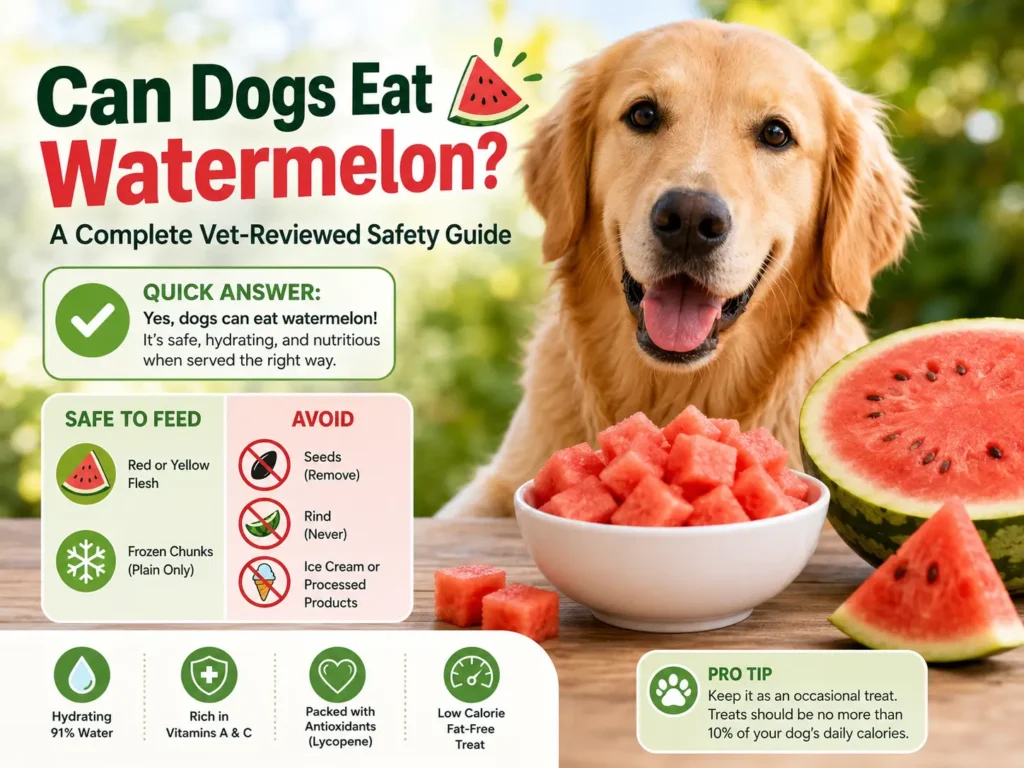
Yes, dogs can eat watermelon. The flesh is non-toxic, hydrating, and safe in moderation, but seeds and rind must always be removed to prevent digestive blockage. Never give watermelon ice cream or other processed watermelon products.
Quick Answer Box
| Question | Answer |
|---|---|
| Safe for dogs? | Yes |
| Red flesh? | Yes |
| Yellow watermelon? | Yes, the same rules apply |
| Seedless watermelon? | Yes, safest choice |
| Seeds? | Always remove |
| Rind? | Never |
| Skin (outer green)? | Never |
| Frozen chunks? | Yes, plain only |
| Watermelon ice cream? | No |
| With added sugar? | No |
| Puppies? | Yes, small pieces only |
| Every day? | Occasional treat, not daily |
Is It Safe for Dogs to Eat Watermelon? What the ASPCA Actually Says
Yes, watermelon is safe for dogs. The ASPCA classifies watermelon (Citrullus lanatus) as non-toxic; both red and yellow flesh are safe. The real risk is the seeds and rind: seeds can cause intestinal blockage, and the fibrous rind is hard to digest. Remove both and serve only the seedless flesh.
Health Benefits of Watermelon for Dogs | What’s Actually in It
Per USDA FoodData Central, here is what 100 grams of fresh watermelon provides:
| Nutrient | Per 100g | Per 1 Cup Diced (~152g) | What It Does for Dogs |
|---|---|---|---|
| Calories | 30 kcal | 45.6 kcal | Low-calorie treat option |
| Natural Sugar | 6.2 g | 9.4 g | Keep portions moderate |
| Dietary Fiber | 0.4 g | 0.6 g | Supports gut motility |
| Vitamin A | 28 mcg RAE | 43 mcg RAE | Vision, immune function, skin |
| Vitamin C | 8.1 mg | 12.3 mg | Immune support, collagen production |
| Vitamin B6 | 0.045 mg | 0.068 mg | Brain health, red blood cell function |
| Potassium | 112 mg | 170 mg | Nerve and muscle function |
| Magnesium | 10 mg | 15.2 mg | Metabolic function, mineral absorption |
| Lycopene | 4,532 mcg | 6,889 mcg | Antioxidant — protects cells from damage |
| Citrulline | ~250 mg | ~380 mg | An amino acid found naturally in watermelon |
| Water Content | 91.4% | 91.4% | Hydration |
Source: USDA FoodData Central
Lycopene | The Antioxidant That Gives Watermelon Its Color
Lycopene is the carotenoid responsible for watermelon’s deep red color, and watermelon is one of the richest natural sources of it. Its antioxidant and anti-inflammatory properties are well documented in human nutrition research (PMC11179732, 2024), but that research doesn’t test dogs specifically. Treat it as a nutritional bonus rather than a proven canine health benefit.
Citrulline | A Natural Compound Worth Knowing About
Watermelon is one of the richest natural sources of L-citrulline, an amino acid the body converts into arginine. In veterinary medicine, citrulline is mainly studied as a blood marker of intestinal health in sick dogs, not as a dietary benefit from foods like watermelon. So while it’s a genuinely interesting compound, there’s no veterinary research showing that feeding watermelon delivers a cardiovascular or kidney benefit through citrulline. It’s included here for nutritional completeness, not as a health claim.
Hydration When It Counts
At 91.4% water, watermelon is one of the most hydrating fruits you can offer a dog. On a hot summer day, wherever temperatures are climbing, a few frozen watermelon cubes help your dog stay cool and hydrated. It does not replace fresh water, but it supplements it well.
Low Calorie, Fat-Free, Cholesterol-Free
30 calories per 100 grams. No fat. No cholesterol. For dogs on a weight management plan, watermelon is a genuinely lower-calorie snack compared to most commercial dog treats.
Can Dogs Eat Watermelon Seeds?
No. Watermelon seeds can cause intestinal blockage, especially in small breeds like Chihuahuas and Yorkies, where even a few swallowed seeds can lead to a serious GI obstruction. Large dogs can usually pass one or two seeds without harm, but removal is still recommended. Even the small white seeds in “seedless” varieties should be removed when possible.
Can Dogs Eat Watermelon Rind?
No. The rind is the firm white-to-pale-green layer between the flesh and the outer skin. It is tough, fibrous, and dogs cannot digest it properly. The Merck Veterinary Manual lists GI obstruction from indigestible plant material as a genuine risk requiring veterinary attention. Swallowing large pieces of rind can cause vomiting, loss of appetite, lethargy, and, in serious cases, a blockage requiring surgery.
Can Dogs Eat Watermelon Green Part or Skin?
No. Watermelon skin, the outermost dark green layer, is not safe for dogs, and it’s often confused with the rind, the lighter white-to-pale-green layer just beneath it. Both the skin and the rind must be removed before serving; neither digests properly, and both carry the same gastrointestinal blockage risk. Only the deep red or yellow flesh is safe to feed.
How Much Watermelon Can a Dog Eat? Serving Sizes by Breed
Serving size depends on your dog’s weight. The UC Davis School of Veterinary Medicine’s 10% treat guideline recommends that treats and extra food make up no more than 10% of a dog’s daily calorie intake, with the remaining 90% coming from a complete, balanced diet. One 1-inch cube of watermelon flesh contains roughly 3 calories, based on USDA data — see the breed-by-breed serving chart below for exact portions.
These amounts are a starting reference point, not a substitute for guidance from your own vet, especially for dogs with health conditions or unusual calorie needs.
| Breed Size | Example Breeds | Weight | Watermelon Per Serving | Approx. Calories |
|---|---|---|---|---|
| Extra Small | Chihuahua, Yorkie, Maltese | Under 10 lbs | 1 small cube | ~3 cal |
| Small | Shih Tzu, Pug, French Bulldog | 10 to 25 lbs | 2 to 3 cubes | ~6 to 9 cal |
| Medium | Beagle, Cocker Spaniel, Border Collie | 25 to 50 lbs | 4 to 5 cubes | ~12 to 15 cal |
| Large | Labrador, Golden Retriever, Husky | 50 to 90 lbs | 6 to 8 cubes | ~18 to 24 cal |
| Giant | Great Dane, Mastiff, Saint Bernard | 90 lbs and up | Up to 10 cubes | ~30 cal |
Can Dogs Eat the Whole Watermelon?
No. A whole watermelon includes the rind, skin, and seeds, all of which must be removed before serving, since none are safe for dogs to eat. Even the flesh alone is far more than any dog should eat in one sitting, and portion size should always follow the breed-based serving chart above rather than be left to instinct.
Can Dogs Eat Watermelon Every Day?
No. Watermelon should be an occasional treat, not a daily food. Using the UC Davis 10% treat guideline, a few servings a week in breed-appropriate portions is the reasonable approach for healthy adult dogs; daily feeding isn’t necessary, and the natural sugar content adds up faster than most owners expect. Rotate with other dog-safe fruits like blueberries or apple slices, and check with your vet first if your dog has diabetes, kidney disease, or is on a restricted diet.
How Often Can Dogs Eat Watermelon?
Two to three times a week, in breed-appropriate portions, is a reasonable target for healthy dogs. Watermelon should stay a treat, not a food staple.
Is Watermelon a Laxative for Dogs?
Not in a clinical sense, but it can have a similar effect in large amounts. Watermelon is 91.4% water and contains dietary fiber. In small amounts, that combination supports normal bowel movements. In larger amounts, especially if your dog eats more than their size-appropriate portion, the water and fiber content can cause loose stools or mild diarrhea. If your dog is already having loose stools, skip the watermelon until their gut settles.
How to Safely Prepare and Feed Watermelon to a Dog
Step 1: Pick a seedless watermelon when you can; it is the safest and most convenient starting point.
Step 2: Wash the outer skin thoroughly before cutting, even if your dog is not eating the skin.
Step 3: Slice off and discard all rind and outer skin. Only the flesh goes to your dog.
Step 4: Remove any remaining seeds, even the small white ones.
Step 5: Cut the flesh into 1-inch cubes appropriate for your dog’s size.
Step 6: First-time feeding watermelon? Give one piece. Wait 24 hours and watch for any stomach reaction before offering more.
Can Dogs Eat Seedless Watermelon?
Yes, seedless watermelon is the best choice for dogs. Less prep work, same great nutrition. Note that seedless varieties may still have small, white,e undeveloped seeds. Those are much less of a concern than mature black seeds, but remove them when you spot them.
Fun Ways to Serve Watermelon to Your Dog
Fresh cubes: Simplest option. Best nutrient retention. Slice and serve.
Frozen chunks: Freeze plain seedless cubes overnight. Hand one out on a hot day. Dogs love the texture and the cooling effect.
Watermelon pupsicles: Blend seedless watermelon flesh, pour into silicone molds with plain unsweetened yogurt, and freeze overnight. Great summer treat.
Lick mat puree: Blend the flesh smooth, spread on a lick mat, and freeze for 30 minutes. Good for anxious dogs and fast eaters.
Kong or enrichment toy filler: Blend and freeze inside a Kong. Keeps your dog busy and cool at the same time.
Watermelon-infused water: Drop a few small pieces into your dog’s water bowl. It encourages dogs that do not drink enough water to stay hydrated — just remove leftover pieces before they break down.
Can Dogs Eat Yellow Watermelon?
Yes. Yellow watermelon is safe for dogs and is the same species as red watermelon (Citrullus lanatus), just a naturally sweeter color variation with honey-like notes. The same rules apply: remove all seeds and rind, and serve only the flesh in moderate portions. It contains less lycopene than red watermelon but still provides vitamins A, C, B6, potassium, and citrulline, making it nutritionally similar overall.
Can Dogs Eat Watermelon Ice Cream?
No. Commercial watermelon ice cream contains high sugar, artificial flavors, and dairy — all of which cause problems for dogs. Most dogs produce less lactase (the enzyme that digests milk sugar) as they mature past puppyhood, so many have at least some difficulty digesting dairy. The sugar content alone exceeds what’s appropriate for any size dog, and some “sugar-free” versions contain xylitol, which is life-threatening: according to the Merck Veterinary Manual and Cornell’s College of Veterinary Medicine, xylitol triggers a rapid insulin release that can cause hypoglycemia within 30 to 60 minutes of ingestion.
The safe swap: freeze plain watermelon chunks or blend them with plain unsweetened yogurt and freeze in molds. Your dog gets the same fun, none of the risk.
When to Avoid Giving Watermelon to Dogs
Diabetic dogs: Watermelon contains 6.2g of natural sugar per 100g. For a dog managing blood sugar, that requires vet guidance before watermelon becomes a regular treat.
Overweight dogs: Low calorie, but all treats still count toward the daily 10% limit. Any dog on a calorie-restricted plan should have watermelon factored into their daily budget.
Dogs with kidney disease: Potassium content at 112mg per 100g needs to be monitored. Check with your vet on appropriate potassium limits.
Sensitive stomachs: The high water and fiber content can trigger loose stools even in moderate portions for dogs with GI sensitivity. Start with one small cube.
Puppies under 8 weeks: Wait until fully weaned and confidently eating solid food.
Signs That Your Dog Ate Too Much Watermelon
These are the signs to watch for if your dog got into a lot of watermelon:
Loose stools or diarrhea: most common outcome, usually from the high water and fiber content hitting the gut too fast.
Bloating or gas: especially in large and giant breeds.
Vomiting: less common but more concerning if it does not stop within a few hours.
Lethargy or reduced appetite: monitor over 24 hours.
Stomach pain: dog hunching, reluctance to move, whimpering.
Most cases of excess watermelon flesh resolve on their own. Remove the watermelon, offer fresh water, and let the gut clear. Symptoms lasting more than 24 hours deserve a vet call.
What if my dog ate the Rind or Seeds?
One or two seeds in a large dog: monitor; likely fine.
Several seeds in a small dog, call your vet.
Any significant amount of rind, especially in a small or medium breed, call your vet. Signs of intestinal blockage include repeated vomiting, complete loss of appetite, straining, and lethargy that worsens over hours. If you are concerned, call ASPCA Animal Poison Control at (888) 426-4435.
Can Puppies Eat Watermelon?
Yes, once fully weaned and eating solid food confidently — typically around 8 weeks and older. Puppy digestive systems are more sensitive than adult dogs’, so start with just one small cube of seedless flesh, with no rind or seeds, and watch for loose stools or vomiting over 24 hours before offering more. Cut adult serving sizes roughly in half for puppies, and consider frozen watermelon cubes for teething puppies, since the cold helps soothe sore gums.
Watermelon vs Other Dog-Safe Fruits
| Fruit | Safe? | Calories per 100g | Key Benefit | Watch For |
|---|---|---|---|---|
| Watermelon | ✅ Yes | 30 kcal | Hydration, low calorie | Remove seeds and rind |
| Strawberries | ✅ Yes | 32 kcal | Vitamin C, antioxidants | Remove tops |
| Blueberries | ✅ Yes | 57 kcal | Brain health, antioxidants | None significant |
| Apples | ✅ Yes | 52 kcal | Fiber, vitamin C | Remove seeds — cyanide |
| Cantaloupe | ✅ Yes | 34 kcal | Beta-carotene, hydration | Remove rind |
| Bananas | ⚠️ Occasionally | 89 kcal | Potassium, magnesium | High sugar |
| Mango | ✅ Yes | 60 kcal | Vitamins A, C, B6 | Remove pit |
| Grapes | ❌ Never | — | None | Causes kidney failure |
| Cherries | ❌ Never | — | None | Pit contains cyanide |
| Avocado | ❌ No | — | None | Skin contains persin |
Sources: USDA FoodData Central | ASPCA Toxic and Non-Toxic Foods List
Can dogs eat watermelon shell?
No. The shell includes the outer green skin and firm rind. Remove both before serving. Only the inner flesh is safe.
How much watermelon can a dog eat a day?
Follow the 10% treat rule from the UC Davis School of Veterinary Medicine. Treats, including watermelon, should make up no more than 10% of your dog’s daily calories. A serving a few times a week is a better choice than offering it every day.
What parts of watermelon should dogs avoid?
Dogs should avoid the seeds, rind, and outer green skin. Only the plain red or yellow flesh is safe to eat.
The Bottom Line
Dogs can eat watermelon. The flesh is ASPCA-confirmed non-toxic, hydrating, and low in calories. Remove the seeds and rind every single time. Keep portions to what the serving size table recommends for your dog’s size. Offer it a few times a week as a treat, not as a daily food. And if your dog eats the rind in any significant amount, call your vet.
This article is for general informational purposes and is not a substitute for individual veterinary advice. If your dog has an existing health condition, check with your veterinarian before adding watermelon or any new food to their diet.
References:
ASPCA Animal Poison Control Center | USDA FoodData Central | Merck Veterinary Manual: Gastrointestinal Obstruction | Merck Veterinary Manual: Xylitol Toxicosis in Dogs | UC Davis School of Veterinary Medicine: Treatment Guidelines for Dogs | Shafe MO, Gumede NM, Nyakudya TT, Chivandi E. “Lycopene: A Potent Antioxidant with Multiple Health Benefits.” J Nutr Metab. 2024;2024:6252426. DOI:10.1155/2024/6252426. PMC11179732 | Dossin O, et al. “Effect of Parvoviral Enteritis on Plasma Citrulline Concentration in Dogs.” J Vet Intern Med. 2011;25(2):215-221. | ASPCA Toxic and Non-Toxic Plant and Food List
Read other Fruits Articles
By Dr. Bradley Pierson, DVM
Dr. Bradley Pierson, DVM, is a veterinarian with 15+ years of experience in small animal medicine, specializing in internal medicine and preventive care. A graduate of the University of Illinois and Fear Free Certified Professional, she writes to help dog owners navigate food safety at every life stage. She has also volunteered extensively in dog shelter care.

Reviewed by Dr. Lara Friedman, DVM
Dr. Lara Friedman, DVM, is a veterinarian with 6+ years of experience across hospital, clinic, and shelter medicine, specializing in canine nutrition and preventive care. A graduate of Colorado State University and a Fear Free Certified Professional®, she writes to help dog owners prevent diet-related health issues before they start. She shares her home with her dog, Duke.