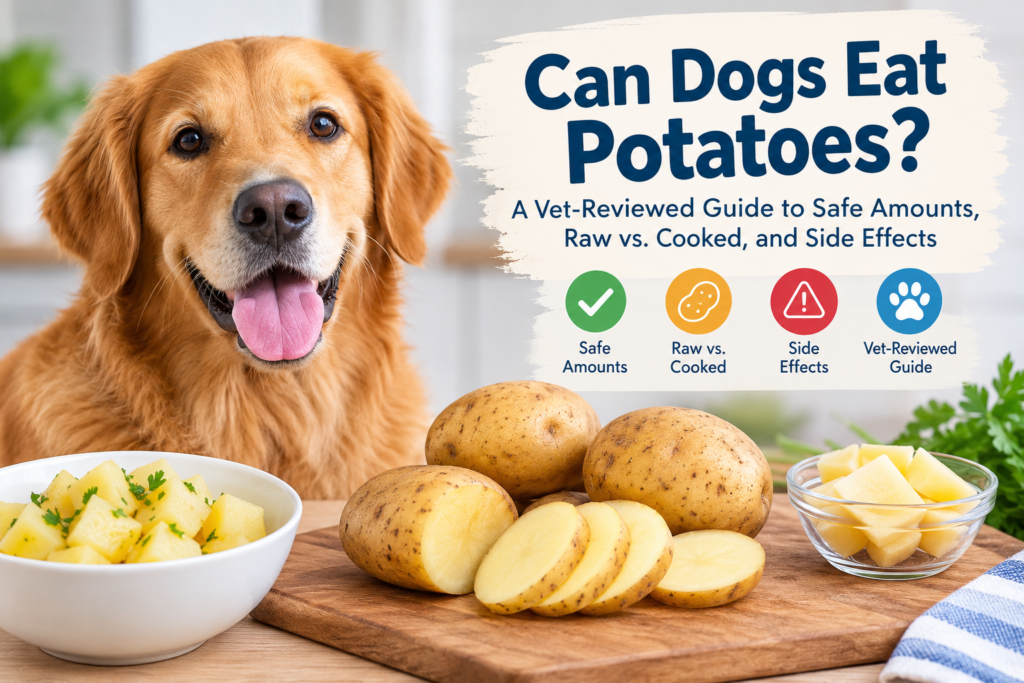
Can Dogs Eat Potatoes? A Vet-Reviewed Guide to Safe Amounts, Raw vs. Cooked, and Side Effects
By Dr. Grace Mullen, DVM. Reviewed By Dr. Bradley Pierson, DVM
Yes, but only in the right form. Plain, peeled, fully cooked potato is safe for most dogs in small amounts. Raw, green, and sprouted potatoes are not, because they carry a natural toxin called solanine. Keep all treats under 10% of daily calories, which is about 1 tablespoon of mashed potato for a 20 pound dog. The chart, nutrition facts, and a plan for “my dog ate it” are below.
Quick facts
- Calories: about 86 per 100 grams of boiled, peeled potato (USDA).
- Treat limit: 10% of daily calories (UC Davis).
- Safe: peeled, fully cooked, plain, cooled, and cut small.
- Not safe: raw, green, sprouted, fried, salted, buttered, or loaded potato.
- Poison help: ASPCA (888) 426 4435 or Pet Poison Helpline (855) 764 7661. Both answer 24 hours a day, and fees apply.
Potato Nutrition for Dogs: What You Get in One Serving
Are potatoes good for dogs? In small amounts, yes. Potato gives starch for energy, a little fiber, and some potassium. It has almost no protein or fat until you add butter or oil.
Boiled Potato Nutrition Facts
Nutritional values per 100 g of boiled, peeled potato
| Nutrient | Amount per 100 g |
|---|---|
| Calories | About 86 kcal |
| Carbohydrate | 20 g |
| Fiber | 1.8 g |
| Protein | 1.7 g |
| Fat | 0.1 g |
| Potassium | About 330 mg |
| Vitamin C | About 7 mg |
| Vitamin B6 | About 0.27 mg |
| Vitamin A | 0 mcg |
Note: These values are approximate and can vary depending on the potato variety and cooking method.
Source: human food entries in USDA FoodData Central.
Complete and balanced dog foods already meet vitamin and mineral needs, as the FDA explains. So potato is a side or a topper, not a supplement. Some pet sites list vitamin A as a potato benefit, but USDA data shows none. A tablespoon of plain mashed potato has about 13 calories.
How Much Potato Can Dogs Eat? Portions by Weight
Treats and extras should stay under 10% of daily calories, with at least 90% from complete and balanced food (UC Davis). Vets estimate daily calories with this formula: 70 × (kilograms of body weight) to the 0.75 power, then × 1.6 for a typical neutered adult (AAHA). Divide pounds by 2.2 to get kilograms.
Potato Serving Guide by Dog Weight
Estimated daily calorie needs, treat limits, and potato portions for dogs.
| Dog Weight | Daily Calories (Estimate) | Treat Limit (10%) | Maximum Potato (Only Treat) | Typical Serving |
|---|---|---|---|---|
| 5 lb | 210 kcal | 21 kcal | 24 g | 1 tsp |
| 10 lb | 350 kcal | 35 kcal | 41 g | 2 tsp |
| 20 lb | 585 kcal | 59 kcal | 69 g | 1 tbsp |
| 40 lb | 985 kcal | 99 kcal | 115 g | 2 tbsp |
| 60 lb | 1,335 kcal | 134 kcal | 156 g | 2 1/2 tbsp |
| 80 lb | 1,655 kcal | 166 kcal | 193 g | 3 tbsp |
Important: These are estimates, not recommended daily potato portions. Treats should generally account for no more than 10% of daily calories. Feed only plain, fully cooked potato, and account for all other treats your dog eats.
The chart assumes a neutered adult with average activity and a level tablespoon of mashed potato at about 15 grams. Puppies, intact dogs, and dogs on weight loss plans need other numbers. The limit covers all treats, so the typical serving is about a quarter of it. For a first taste, give 1 teaspoon and wait a day.
Can Dogs Eat Raw Potatoes? Why Raw, Green, and Sprouted Are Out
No. Raw potato carries more solanine than cooked potato, is hard to chew, and can lodge in the throat or gut. Cornell lists vomiting, lost appetite, and belly pain as the usual blockage signs, and says most blockages need surgery.
Can dogs eat raw potatoes without skin? No. Peeling cuts solanine, but raw potato still has some, and the hard chunks are a choking risk.
Can dogs eat raw potatoes with skin? No. The highest solanine levels sit just under the skin (JAAHA, 2012).
Solanine Explained: Does Cooking Make Potatoes Safe?
Not fully. Solanine and chaconine are natural toxins in potato plants, which belong to the nightshade family. A veterinary case report reviewing the research says commercial potatoes usually hold under 0.2 mg per gram, while green ones can approach 1 mg per gram (JAAHA, 2012). The highest levels sit just under the skin, and light can speed up production to five times the rate in dark storage. Green color is a warning sign, but greening and toxin buildup happen as separate events. So also toss sprouted, bruised, or sun exposed potatoes.
How much harms a dog? Nobody knows, because dog data is thin. In people, 2 to 5 mg per kilogram is toxic. The report’s author estimates that one large green raw potato could badly poison a 44 pound dog. The same report notes that solanine is poorly absorbed and cleared quickly. EFSA, Europe’s food safety agency, also found pet data too limited to rate the risk (EFSA).
Solanine Reduction by Cooking Method
Typical reduction in potato glycoalkaloids by preparation method
| Preparation Method | Typical Solanine Reduction |
|---|---|
| Peeling | 25–75% |
| Boiling peeled potatoes | 5–65% |
| Baking unpeeled potatoes | 20–50% |
| Frying | 20–90% |
Safety note: Cooking does not reliably eliminate potato glycoalkaloids. Never feed dogs green, heavily sprouted, bitter, or spoiled potatoes. Serve only plain, thoroughly cooked potatoes in moderation.
You may read that boiling is unsafe, or that cooking makes any potato safe. The data support neither. Heat only lowers the amount, so no cooking method makes a green potato safe.
Can Dogs Eat Cooked Potatoes? Boiled, Baked, and Roasted
Yes, if they are peeled, fully cooked, plain, and cooled. Soft potato also lowers the choking risk. Potatoes cooked in plain water or baked dry are the safest choices.
Can dogs eat boiled potatoes with skin? Peel first. Boiling a peeled potato cuts solanine, and the skin holds the most. Boil until a fork slides in, add no salt to the water, and cool before serving.
Can dogs eat baked potatoes? Yes, peeled and plain. Skip butter, sour cream, cheese, bacon, and chives. A medium baked potato with skin has about 160 calories, which is more than the whole treat limit for a 40 pound dog.
What about roasted potatoes? Only dry roasted, with no oil or seasoning. Herb butter and drippings add fat, and table scraps are a listed risk factor for pancreatitis, a painful swelling of the pancreas (veterinary review).
Can Dogs Eat Mashed Potatoes? Plain, Instant, and With Gravy
Yes, if they are plain. Boil peeled potatoes and mash them with a splash of warm water, with no milk, butter, or salt. The smooth texture suits seniors and dogs with sore teeth. Spread it on a lick mat or stir a spoonful into kibble.
Can dogs eat instant mashed potatoes? Skip them. Many mixes add salt, dairy, and flavorings. Read the label if you are unsure.
Can dogs eat mashed potatoes and gravy? No. Gravy adds fat and salt, and many gravies and stuffings contain onion or garlic, which the ASPCA lists as toxic. At Thanksgiving, scoop a plain spoonful aside before you season the pot.
Can Dogs Eat Potato Skins and Peels?
Peel your potatoes. The skin and the layer under it hold most of the solanine, and peeling removes 25 to 75% of it. Peeling costs nothing.
Can dogs eat raw potato skins? No. They are tough and carry the highest solanine load.
Can dogs eat cooked potato skins? One small piece will not likely hurt, but peel anyway.
Can dogs eat baked potato skins? Restaurant style skins come loaded with bacon, cheese, and chives. Even a plain baked skin is the highest solanine layer.
Can dogs eat potato peels? Not from the trash. In the 2012 case report, a beagle got sick after eating green potato skin scraps that fell near her. Keep kitchen trash and compost covered.
What about oxalates, the compounds some pet sites blame for kidney damage? A human food oxalate list shows boiled potato at about 23 mg per 100 grams and baked russet with skin at about 46 mg, versus 567 mg in cooked spinach (Oxalosis and Hyperoxaluria Foundation). That is low to moderate. Dog data is limited, so the kidney warning looks overstated for healthy dogs. Dogs with a stone history should skip skins.
Chips, Fries, and Other Fried Potatoes
Can dogs eat potato chips? No. They bring fat and salt. The Merck Veterinary Manual says salt poisoning is unlikely when a dog has fresh water. The bigger worry is fat and pancreatitis.
Can dogs eat fried potatoes? No, for the same reasons. One stray chip is not an emergency. A basket of drive thru fries calls for watching: vomiting, belly pain, or no appetite means a call to your vet.
Can Dogs Eat Potato Salad? Cookout and Holiday Sides Ranked
No. Potato salad has mayonnaise fat, salt, and often onion or relish. Cookouts and holidays bring many other potato dishes.
Potato Dishes: Which Are Safe for Dogs?
Common potato dishes and what makes them unsuitable or safer for dogs.
| Dish | Verdict | Why |
|---|---|---|
| Potato salad | No | Mayonnaise fat, onion, salt |
| Mashed with gravy | No | Gravy fat, salt, onion, garlic |
| Loaded baked potato or skins | No | Bacon, cheese, chives, sour cream |
| Scalloped or au gratin | No | Cheese, cream, onion |
| Hash browns, tater tots | No | Oil and salt |
| Drive-thru fries | No | Oil and salt |
| Sweet potato casserole | No | Sugar, butter, marshmallows |
| Plain boiled potato set aside before seasoning | Yes, small | No added ingredients |
Tip: If sharing potato with your dog, set aside a small portion before adding salt, butter, oil, gravy, sauces, or seasonings. Always serve it fully cooked, plain, and cooled.
White, Red, Russet, and Purple Potatoes: Does the Type Matter?
No. They are all common potatoes, so one set of rules applies: peel, cook, serve plain, and discard green or sprouted ones.
Can dogs eat white potatoes?
Yes. Yukon Gold counts as white.
Can dogs eat red potatoes?
Yes. Peel the thin skin.
Can dogs eat russet potatoes?
Yes. A medium baked russet is far too many calories for most dogs.
Can dogs eat purple potatoes?
Yes. Color does not change the rules.
Can Dogs Eat Sweet Potatoes? How They Differ From White Potatoes
Yes, cooked and plain. Sweet potato is a different plant, not a nightshade, so solanine is not the issue. Calories and starch still count toward the 10% limit. A veterinary journal lists sweet potato among foods high in oxalate, which matters for dogs prone to bladder stones (Today’s Veterinary Practice). Raw, skin, fries, pie, and purple varieties are covered in our full sweet potato guide [link to page 2].
Side Effects and Real Cases: What Can Go Wrong After Potatoes
Potential Risks of Feeding Potatoes to Dogs
Warning signs, possible problems, and supporting evidence.
| Problem | What You May See | Evidence |
|---|---|---|
| Solanine poisoning | Drooling, vomiting, belly pain, drowsiness, weakness, dilated pupils, slow heart rate | ASPCA, 2012 case |
| Pancreatitis | Vomiting, belly pain, no appetite | Cornell |
| Onion or garlic toxicity | Vomiting, weakness | ASPCA |
| Choking or blockage | Gagging, pawing at mouth, vomiting | Red Cross, Cornell |
| Gas or loose stool | After a big first serving | Start small |
| Weight gain | Extra pounds over time | 59% of U.S. dogs overweight (APOP) |
| Blood sugar spike | Concern in diabetes | 20 g carbohydrate per 100 g |
| Food reaction | Itching, vomiting, loose stool | Stop and call your vet |
Safety reminder: If your dog eats a raw or green potato, potato sprouts, or food containing onion or garlic, contact your veterinarian for advice. Seek urgent veterinary care for choking, severe weakness, repeated vomiting, or a slow or irregular heartbeat.
A documented case. A 21 pound beagle was rushed in after vomiting for hours. She had eaten a few green potato skin pieces. Her signs included belly pain, dilated pupils, a slow heart rate of 55, and later weakness and tremors. Doctors then found she had also chewed roots of a garden shrub, the “Yesterday, Today, and Tomorrow” plant, which was blamed for most of the severe signs. She recovered after about 48 hours. The case shows that early potato signs were stomach upset and a slow heart rate. It does not show potato alone causing severe poisoning.
Garden check. Potato leaves and stems also hold solanine. The case report says that shrub is widely sold at U.S. garden centers, so check your yard too.
My Dog Ate Potato: What to Do Step by Step
A bite of plain cooked potato needs no call. For raw, green, sprouted, or seasoned potato:
- Take away the rest. Note what your dog ate, how much, when, and your dog’s weight.
- Call your vet or the nearest 24 hour emergency animal hospital.
- Or call the ASPCA at (888) 426 4435 or the Pet Poison Helpline at (855) 764 7661. Fees apply.
- Do not induce vomiting or give milk or home remedies unless a professional says so (Pet Poison Helpline, University of Illinois).
- Stay with your dog and watch for drooling, vomiting, belly pain, wobbling, or tremors.
- Go to the emergency clinic now for repeated vomiting, tremors, collapse, or trouble breathing.
Save your regular vet and your nearest 24 hour clinic in your phone before you need them.
Which Dogs Need Extra Care With Potatoes?
- Stone prone breeds: Miniature Schnauzers, Lhasa Apsos, Yorkshire Terriers, Miniature Poodles, Shih Tzus, and Bichon Frises are at higher risk of calcium oxalate stones. Diet cannot dissolve them, so vets focus on prevention (VIN Veterinary Partner). Ask before feeding potato.
- Diabetes: Potato is starchy. Ask your vet first.
- Overweight dogs: Ask for a calorie target before using the chart.
- Pancreatitis history: Cornell says most dogs that survive it stay on a strict low fat, low protein diet. Ask first.
- Prescription diets: VCA notes that extras can undermine them. Ask first.
- Puppies: Most calories should come from puppy food. Use tiny pieces.
Potato Dog Foods and the FDA Heart Disease Investigation
In 2018 the FDA began investigating heart disease reports in dogs eating foods with peas, lentils, other legumes, and potatoes as main ingredients (FDA). It says report counts alone do not prove a cause, and it has not named one. A spoonful of potato on top of balanced food is a different thing than a diet built on potato. If your dog eats a grain free food, ask your vet about it.
How to Serve Potatoes Safely in 6 Steps
- Buy firm potatoes. Store them cool, dark, and dry.
- Wash and peel. Cut away eyes, sprouts, green spots, and bruises.
- Boil or bake plain until soft.
- Cool, then mash with water or cut small.
- Start with 1 teaspoon and watch for a day.
- Count it in the 10% treat budget.
Quick Answers
Can dogs eat potatoes every day? It is not a good habit. Potato adds mostly starch. If your dog is healthy, a daily spoonful fits inside the 10% limit, but there is little reason to.
Can puppies eat potatoes? Yes, in tiny plain amounts. Puppy food should supply nearly all calories.
Can potatoes replace part of my dog’s food? No. The FDA says treats are usually not complete and balanced.
Can dogs eat potato leaves or vines? No. Leaves and stems hold solanine.
Is it potatoes, potatos, or potatoe? Potatoes is correct. People also search “can dogs eat potatos” and “can dogs eat potatoe.” The answer is the same: plain, peeled, cooked, small amounts.
This article is general information, not a diagnosis. Your vet knows your dog’s health history.
Read more about can dogs eat vegetables
Sources
- UC Davis, Treat Guidelines for Dogs
- AAHA 2021 Nutrition Guidelines, Energy Calculations
- USDA FoodData Central
- FDA, “Complete and Balanced” Pet Food
- JAAHA 2012, Brunfelsia and Solanum Poisoning in a Dog
- EFSA, Glycoalkaloids in Potatoes
- Merck Veterinary Manual, Salt Toxicosis
- Cornell, Foreign Body Obstruction in Dogs
- Cornell Riney Canine Health Center, Treats and Scraps
- Canine pancreatitis risk factors (PubMed Central)
- ASPCA, People Foods to Avoid
- ASPCA, Nightshade
- Oxalosis and Hyperoxaluria Foundation, Vegetable Oxalate List
- VIN Veterinary Partner, Oxalate Bladder Stones in Dogs
- Today’s Veterinary Practice, Canine Calcium Oxalate Urolithiasis
- APOP, 2022 Pet Obesity Survey
- American Red Cross, Dog Choking
- Pet Poison Helpline, Top Ten Things to Remember
- University of Illinois, Household Toxins
- FDA, Diet and Canine Heart Disease Investigation
- VCA Animal Hospitals, Dog Treats
Written By Dr. Grace Mullen, DVM
Dr. Bradley Pierson, DVM, is a veterinarian with 15+ years of experience in small animal medicine, specializing in internal medicine and preventive care. A graduate of the University of Illinois and Fear Free Certified Professional, she writes to help dog owners navigate food safety at every life stage. She has also volunteered extensively in dog shelter care.
Reviewed By Dr. Bradley Pierson, DVM
Dr. Bradley Pierson, DVM, is a veterinarian with 15+ years of experience in small animal medicine, specializing in internal medicine and preventive care. A graduate of the University of Illinois and Fear Free Certified Professional, she writes to help dog owners navigate food safety at every life stage. She has also volunteered extensively in dog shelter care.