Can Dogs Eat Honey? Vet-Reviewed Safe Amounts, Raw vs. Pasteurized, and Honey Foods

By Dr. Grace Mullen, DVM. Reviewed By Dr. Lara Friedman, DVM
Published: 29 October, 2026
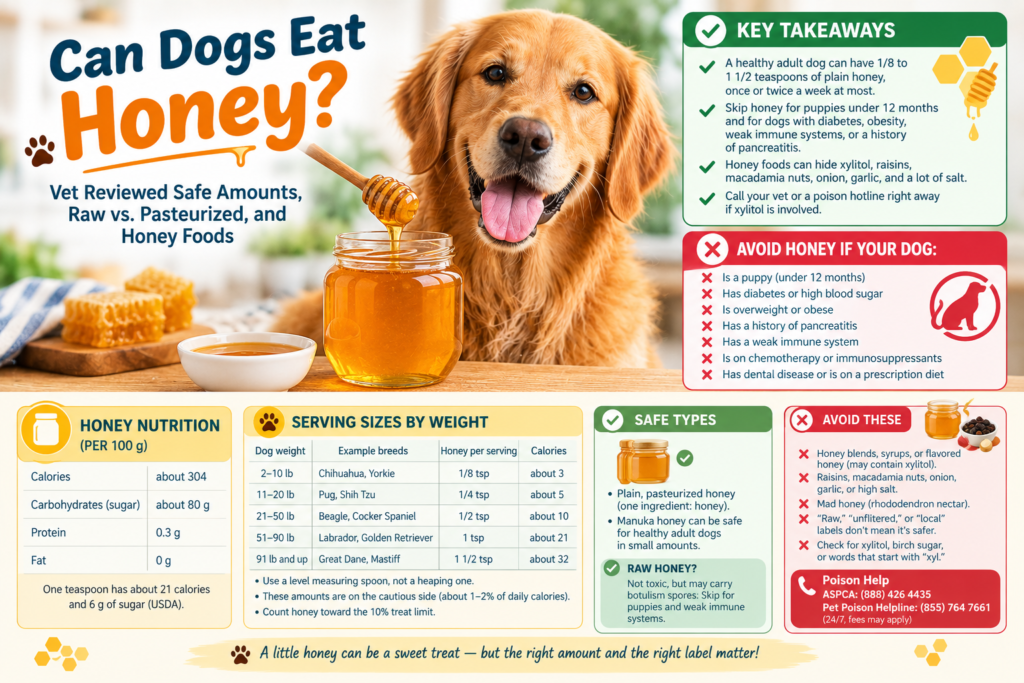
Yes, most healthy adult dogs can have a small taste of plain honey once in a while. Honey is not poisonous, but it is mostly sugar, and many foods with honey in the name are not safe for dogs. Puppies, diabetic dogs, overweight dogs, and dogs with weak immune systems should skip it. This guide gives serving sizes by weight, a food-by-food chart, and steps to take if your dog got into the jar.
Key takeaways
- A healthy adult dog can have 1/8 to 1 1/2 teaspoons of plain honey, based on weight, once or twice a week at most.
- Skip honey for puppies under 12 months and for dogs with diabetes, obesity, weak immune systems, or a history of pancreatitis.
- Honey foods can hide xylitol, raisins, macadamia nuts, onion, garlic, and a lot of salt.
- Call your vet or a poison hotline right away if xylitol is involved.
Can Dogs Eat Honey? The Short Answer
Can dogs eat honey? Yes, healthy adult dogs can eat a small amount of plain honey as an occasional treat. Honey is not toxic to dogs. It is about 80 percent sugar, so too much can cause an upset stomach, weight gain, and tooth problems. Puppies, diabetic dogs, and dogs with weak immune systems should not have it.
One teaspoon of honey has about 21 calories and 6 grams of sugar, based on USDA FoodData Central values. Dogs do not need honey, because a complete dog food already covers their nutrition. Treats of every kind should stay under 10 percent of daily calories, according to the American Animal Hospital Association.
Dogs that should skip honey
- Puppies under 12 months old
- Dogs with diabetes or high blood sugar
- Overweight dogs. Tufts University reports that 25 to 40 percent of middle-aged dogs and cats are overweight or obese.
- Dogs with a history of pancreatitis, unless your vet says yes
- Dogs on chemotherapy or drugs that weaken the immune system
- Dogs with dental disease, since sugar feeds plaque bacteria
- Dogs on a prescription diet
Can Dogs Eat Honey Safely? Serving Sizes by Dog Weight
How much honey can a dog have? Most healthy adult dogs can have 1/8 to 1 1/2 teaspoons, based on size, once or twice a week at most. Small dogs get the small end. Start with half the serving and watch for vomiting or loose stool for 24 hours.
| Dog Weight | Example Breeds | Honey per Serving | Calories |
|---|---|---|---|
| 2 to 10 lb | Chihuahua, Yorkie | 1/8 tsp | About 3 |
| 11 to 20 lb | Pug, Shih Tzu | 1/4 tsp | About 5 |
| 21 to 50 lb | Beagle, Cocker Spaniel | 1/2 tsp | About 10 |
| 51 to 90 lb | Labrador, Golden Retriever | 1 tsp | About 21 |
| 91 lb and up | Great Dane, Mastiff | 1 1/2 tsp | About 32 |
- Use a level measuring spoon, not a heaping one.
- These amounts are on the cautious side. For a typical adult dog, they equal about 1 to 2 percent of daily calories (our estimate from standard calorie formulas). Your vet may adjust them for age, health, and activity.
- Count honey toward the 10 percent treat limit.
Can Dogs Eat Honey Every Day?
Is it okay to give a dog honey daily? No. Honey is best as an occasional treat, no more than once or twice a week. Daily honey adds sugar and calories your dog does not need, and extra weight raises the risk of joint pain and diabetes.
A long-term study described in a Tufts University newsletter found that dogs just 10 to 20 percent over their ideal weight lived almost two years less than lean dogs. A teaspoon here and there is small. A daily spoonful is not.
Can Dogs Eat Raw Honey, Raw Unfiltered Honey, or Pure Honey?
Is raw honey safe for dogs? Raw honey is not toxic to healthy adult dogs, but it can carry spores of Clostridium botulinum, the germ behind botulism. Adult dogs are fairly resistant, so the risk is low. Still, skip raw honey for puppies and for dogs with weak immune systems. The benefit is small, and the downside is serious.
Whether the jar says raw honey, raw unfiltered honey, or pure honey, the same rules apply.
The botulism question in plain words
Honey is a known source of botulism spores. A U.S. survey found spores in about 10 percent of honey samples, according to University of Florida extension scientists. That is why the CDC and the American Academy of Pediatrics say no honey for babies under 12 months. Their guts and immune systems are still developing.
Dogs are different. The Merck Veterinary Manual says botulism is rare in dogs and usually comes from rotting animal remains or spoiled plants. Its professional edition calls dogs comparatively resistant to the toxin. We did not find a published case of honey causing botulism in a dog in the sources we reviewed. Many vets still use caution with puppies because their bodies are still maturing.
Signs of botulism in dogs include growing weakness, trouble chewing or swallowing, vision problems, and paralysis. Treat any of these as an emergency.
Pasteurizing may lower the risk, but it is not a guarantee. Medical-grade honey is sterilized with gamma radiation to destroy spores, according to veterinary researchers at Hebrew University.
How to read a honey label
- Pick a jar with one ingredient: honey.
- Skip honey blends, syrups, and flavored or infused honey. Some have added sweeteners, and xylitol is dangerous for dogs, per the FDA.
- Raw, unfiltered, and local describe how honey was handled. They do not prove it is safer.
- Skip mad honey, made from rhododendron nectar. Its grayanotoxins cause dizziness, low blood pressure, and heart rhythm problems in people, according to a review in Cardiovascular Toxicology.
Can Dogs Eat Manuka Honey?
Is manuka honey better for dogs than regular honey? Not for eating. Manuka honey has the same sugar load as other honey. Its real value in dog care is medical-grade manuka applied to wounds by a vet.
A 2024 study in the American Journal of Veterinary Research found that medical-grade honey stopped wound bacteria in dogs and cats better than other honeys in lab tests. A 2020 review in Veterinary Record noted that no published trial had yet compared wound healing in dogs with and without medical-grade manuka honey. So the promise is real, but the proof in dogs is still thin. Never pack kitchen honey into a deep or infected wound. See your vet.
Can Dogs Eat Honey for a Sore Throat or Kennel Cough?
Does honey help a dog’s cough? No study shows it does in dogs. Honey may ease cough in people, based on a 2021 review of trials. But a dog’s cough can have many causes, and some are serious. Call your vet first. If your vet agrees, stay within the serving chart above.
Can Dogs Eat Honey for Allergies? What the Science Says
Does local honey help dogs with allergies? There is no proof that it does. The idea is that tiny amounts of local pollen train the immune system. In a randomized trial in people, local honey worked no better than a placebo (Rajan and colleagues, Annals of Allergy, Asthma & Immunology, 2002). The American College of Allergy, Asthma and Immunology says there is no scientific proof it helps. We found no studies in dogs.
| Common Claim | Evidence in Dogs | Our Take |
|---|---|---|
| Soothes cough or throat | None in dogs | Ask your vet first |
| Relieves seasonal allergies | None in dogs, weak in people | Not proven |
| Heals wounds | Medical grade honey used by vets | Vet use only |
| Helps digestion | None in dogs | Not proven |
| Gives energy | Sugar is quick fuel | Dogs do not need it |
| Helps weight control | None, honey adds calories | No |
Why Do Vets and Pet Brands Disagree About Honey?
Why do sources give different advice about honey for dogs? Honey is not toxic, so groups like the American Kennel Club call small amounts acceptable. Some pet brands say skip it because dogs gain nothing they need and sugar adds risk. Both sides agree on small, occasional, and never for puppies or diabetic dogs.
Where the advice splits:
- How often. Some pages say daily. Weight data and the AAHA treat limit point to occasional.
- Raw honey. Some pages call it best. Others say avoid it. See the botulism section above.
- Health claims. Many pages promise cures, but studies in dogs are missing.
Your best move is to follow your own vet, check who wrote and reviewed what you read, and look for links to real studies.
Honey Foods Chart: Safe, Caution, or Avoid
Which honey foods are safe for dogs? Plain honey in small amounts and honeydew flesh are okay. Most packaged foods with honey in the name are mostly sugar, salt, or fat, and some contain toxic additives. Always check labels for xylitol, raisins, macadamia nuts, onion, and garlic.
| Food | Verdict | Main Concern |
|---|---|---|
| Honey Nut Cheerios, Honey Cheerios | Caution | Sugar, no nutrition |
| Honey Bunches of Oats | Caution | Sugar, raisins or almonds in some boxes |
| Plain oatmeal with a pinch of honey | Okay, small | Skip flavored packets |
| Granola with honey | Avoid | Raisins, chocolate, macadamia, xylitol |
| Honey graham crackers | Caution | Sugar |
| Honey buns | Avoid | Sugar, fat |
| Cornbread with honey | Caution | Sugar, butter |
| Honey ham, honey baked ham | Avoid | Salt, fat, bones |
| Honey turkey deli meat | Avoid | Sodium, garlic, onion |
| Honey mustard, honey mustard pretzels | Avoid | Salt, onion, garlic |
| Honey roasted nuts | Avoid | Macadamia, fat, salt |
| Yogurt with honey | Caution | Lactose, xylitol, added sugar |
| Honeycrisp apples | Okay | Remove core and seeds |
| Honeynut squash | Okay | Serve plain and cooked |
| Honey mango | Okay, small | Remove skin and pit |
| Honeydew melon | Okay, small | Remove rind and seeds |
Honey Nut Cheerios, Honey Cheerios, and Honey Bunches of Oats: Are They Okay for Dogs?
Can dogs eat Honey Nut Cheerios? A few pieces will not poison most dogs. The cereal is mostly sugar and refined grain, so it gives your dog nothing it needs. Keep it rare, and skip it for diabetic or overweight dogs. Honey Cheerios follow the same rule.
With milk, or as a morning habit
Dogs have little lactase, the enzyme that digests milk sugar, so milk can cause diarrhea, the ASPCA notes. A shared bowl every morning also adds sugar and calories fast. A few dry pieces as a rare treat is the safer way.
What Reddit threads say
Reddit threads on this topic can sound calm or scary, depending on who posts. Treat them as stories, not safety tests. Your dog’s size, age, and health matter more than any thread.
Honey Bunches of Oats
Some boxes add almonds, dried fruit, or raisins. The ASPCA says raisins and grapes can cause kidney failure in dogs, so check the box before you share.
Oats and Honey, Oatmeal With Honey, and Granola With Honey
Can dogs eat oatmeal with honey? Plain cooked oatmeal is fine for most dogs in small portions, with no more than a pinch of honey from the serving chart. Flavored instant oatmeal and granola are riskier because they often have extra sugar, raisins, chocolate, macadamia nuts, or xylitol.
Granola with honey and oats and honey granola bars deserve the most caution. Read every ingredient. Plain old-fashioned oats cooked in water are the better pick.
Honey Graham Crackers, Honey Maid, and Teddy Grahams
Can dogs eat graham crackers with honey? One small piece will not hurt most dogs. Honey graham crackers, including Honey Maid and Teddy Grahams, are mostly sugar and flour. They are a poor snack, so skip them for dogs with diabetes or weight problems.
Honey Buns and Cornbread With Honey
Are honey buns bad for dogs? Yes, they are a poor choice. A packaged honey bun is loaded with sugar, fat, and icing. A lick likely will not hurt, but a whole bun can cause vomiting and diarrhea. The ASPCA also lists fatty foods as a pancreatitis risk.
A small bite of plain cornbread is okay. Sweet cornbread adds sugar, and butter adds fat. Some recipes include onion, jalapeño, or cheese, so read before you share.
Honey Ham, Honey Baked Ham, Honey Turkey, and Honey Turkey Deli Meat
Can dogs eat honey baked ham? It is best to skip it. Glazed ham is high in salt, fat, and sugar. The ASPCA warns that too much salt can cause vomiting, diarrhea, tremors, and seizures, and fatty holiday meat can trigger pancreatitis. Ham bones add a second risk, since swallowed bone pieces can block the gut.
Honey ham, lunch meat, and honey turkey deli meat are processed. They carry a lot of sodium and may include garlic or onion powder, which can damage a dog’s red blood cells, per the ASPCA. A small piece of plain cooked turkey with no seasoning is a better choice.
Honey Mustard, Honey Mustard Pretzels, and Honey Wheat Pretzels
Is honey mustard toxic to dogs? A lick is unlikely to cause trouble, but it is not a good treat. Many brands contain onion powder, garlic powder, and plenty of salt. The ASPCA also tells owners to avoid salty snacks like pretzels. Keep honey mustard pretzels and honey wheat pretzels in the pantry, not in the dog bowl.
Honey Roasted Cashews and Honey Roasted Almonds
Are honey roasted nuts safe for dogs? Skip them. They are salty, sugary, and high in fat. Mixed cans often hide macadamia nuts, which can cause weakness, tremors, vomiting, and high body temperature within about 12 hours, says the ASPCA. Almonds, pecans, and walnuts can cause vomiting, diarrhea, and pancreatitis. Cashews share the same fat and salt problem.
Yogurt With Honey, Greek Yogurt With Honey, and Honey Vanilla Greek Yogurt
Can dogs eat honey vanilla Greek yogurt? A small lick will not hurt most dogs, but plain unsweetened yogurt is the better pick. Flavored cups add sugar, and some low-sugar brands use xylitol. Dairy can also cause gas and loose stool. If you want honey on top, use a serving from the chart on plain yogurt.
Can Dogs Eat Honeydew? Honeydew Melon, Honey Dew, and Honey Melon
Can dogs eat honeydew melon? Yes. Honeydew flesh is a safe treat for most dogs in small amounts. Remove the rind and seeds first. The rind is tough to digest and can cause a blockage, mostly in small dogs.
Honey and honeydew are different foods.
Honeydew is a melon, not a honey product, so it follows different rules. It is about 90 percent water, with roughly 36 calories and 8 grams of sugar per 100 grams, per USDA FoodData Central. Searches for honey melon usually mean honeydew or a similar sweet melon. The same rules apply.
How to serve it
- Wash the outside of the melon, then cut it open.
- Scoop out every seed and cut the flesh away from the rind.
- Cut the flesh into bite-size cubes.
- Offer a few cubes to a small dog or up to about 1/4 cup to a large dog, a couple of times a week.
Frozen cubes make a cool summer treat. Skip melon for diabetic dogs, since it still has natural sugar. If your dog ate rind and starts vomiting again and again or stops eating, call your vet. Those can be signs of a blockage.
Honeycrisp Apples, Honeynut Squash, and Honey Mango
These foods have honey in the name but no honey in the food.
Are Honeycrisp apples safe for dogs? Yes. Honeycrisp is just an apple variety. Serve a few slices and remove the core and seeds. The ASPCA says apple seeds contain cyanide-forming compounds. A few seeds rarely hurt a large dog, but remove them every time.
- Honeynut squash: a small butternut type. Serve cooked and plain, with no butter, brown sugar, or onion.
- Honey mango: the flesh is fine in small pieces. Remove the skin and the pit, since the pit can block the gut.
My Dog Ate Honey or a Honey Food: What to Do
What happens if a dog eats too much honey? Most dogs get loose stool or vomiting within hours, and many bounce back at home. Honey itself is not poisonous. The bigger danger is what else is in the food, like xylitol, raisins, or macadamia nuts.
Steps to take
- Take the food away and keep the wrapper.
- Note what and how much your dog ate, when, and your dog’s weight.
- Read the ingredients for xylitol, raisins, macadamia nuts, chocolate, onion, and garlic.
- Call your vet. After hours, call an emergency vet or a poison hotline: ASPCA Animal Poison Control at 888.426.4435 (a consultation fee may apply) or Pet Poison Helpline at 855.764.7661. Check their sites for current numbers and fees.
- Do not make your dog vomit unless a vet tells you to.
Call right away if
- The food had xylitol. Blood sugar can drop within 10 to 60 minutes, and liver damage can follow, per the FDA.
- Your dog ate macadamia nuts, raisins, or grapes.
- Your dog is a puppy, a toy breed, or diabetic.
- You see weakness, tremors, stumbling, a swollen belly, or nonstop vomiting.
- Your dog ate melon rind or a mango pit and has belly pain or repeated vomiting.
How to Give Honey to Your Dog Safely
- Measure a level spoon from the chart. Start with half.
- Stir it into regular food, or mix it into plain unsweetened yogurt and freeze it in an ice cube tray.
- Brush your dog’s teeth afterward, or offer a dental chew.
- Close the jar and store it high. A dog that finds an open jar can eat far more than a safe serving.
Never leave a honey spoon out, add honey to a water bowl, or give honey to a diabetic dog.
Frequently Asked Questions
Can puppies have honey?
No. Wait until your puppy is at least 12 months old, and ask your vet first. Puppies are still developing, and they do not need honey.
Can diabetic dogs have honey?
No. Honey is mostly sugar and can spike blood sugar. Ask your vet about safer treats.
Can dogs with pancreatitis have honey?
Honey has no fat, but vets usually keep extras to a minimum for dogs with a history of pancreatitis. Ask your vet before offering any.
Can dogs eat honeycomb?
Skip it. Beeswax does not digest well, and large chunks can cause a blockage.
Is honey a natural antibiotic for dogs?
Medical-grade honey fights bacteria in labs and is used by vets on wounds. Eating honey does not treat an infection, and it never replaces antibiotics.
What can I give instead of honey?
Try blueberries, carrot sticks, plain cooked green beans, or apple slices without seeds. Keep all treats under 10 percent of daily calories.
How This Article Was Reviewed
This article is general education, not a diagnosis. It draws on veterinary references, federal agencies, and peer-reviewed studies. No product is sold on this page. Call your vet about your own dog.
References
- USDA FoodData Central. Honey and honeydew melon nutrient data.
- American Animal Hospital Association. 2021 Nutrition and Weight Management Guidelines for Dogs and Cats.
- Tufts University. Pet nutrition and weight. https://now.tufts.edu/articles/pet-nutrition and
- University of Florida IFAS Extension. Honey and infant botulism (AA142).
- Merck Veterinary Manual. Botulism in dogs.
- Merck Veterinary Manual. Botulism.
- Merck Veterinary Manual. Gastrointestinal obstruction in small animals.
- VCA Animal Hospitals. Foreign bodies in dogs.
- ASPCA. People foods to avoid feeding your pets.
- ASPCA. Apple (toxic and non-toxic plants).
- U.S. Food and Drug Administration. Paws off xylitol, it’s dangerous for dogs.
- Neo R, et al. American Journal of Veterinary Research. 2024.
- Brennan M, Belshaw Z. Veterinary Record. 2020.
- Abuelgasim H, et al. BMJ Evidence-Based Medicine. 2021.
- Rajan TV, et al. Annals of Allergy, Asthma & Immunology. 2002. American College of Allergy, Asthma and Immunology:
- Jansen SA, et al. Grayanotoxin poisoning: mad honey disease and beyond. Cardiovascular Toxicology. 2012.
- Hebrew University Koret School of Veterinary Medicine. Medical-grade honey sterilization summary.
- Pet Poison Helpline.
Written By Dr. Grace Mullen, DVM
Dr. Bradley Pierson, DVM, is a veterinarian with 15+ years of experience in small animal medicine, specializing in internal medicine and preventive care. A graduate of the University of Illinois and Fear Free Certified Professional, she writes to help dog owners navigate food safety at every life stage. She has also volunteered extensively in dog shelter care.

Reviewed By Dr. Lara Friedman, DVM
Dr. Lara Friedman, DVM, is a veterinarian with 6+ years of experience across hospital, clinic, and shelter medicine, specializing in canine nutrition and preventive care. A graduate of Colorado State University and a Fear Free Certified Professional®, she writes to help dog owners prevent diet-related health issues before they start. She shares her home with her dog, Duke.