Can Dogs Eat Peanut Butter? A Vet Reviewed US Guide to Safe Types, Amounts, and Xylitol

By Dr. Lorenzo Bertelli. Reviewed By Dr. Lara Friedman, DVM
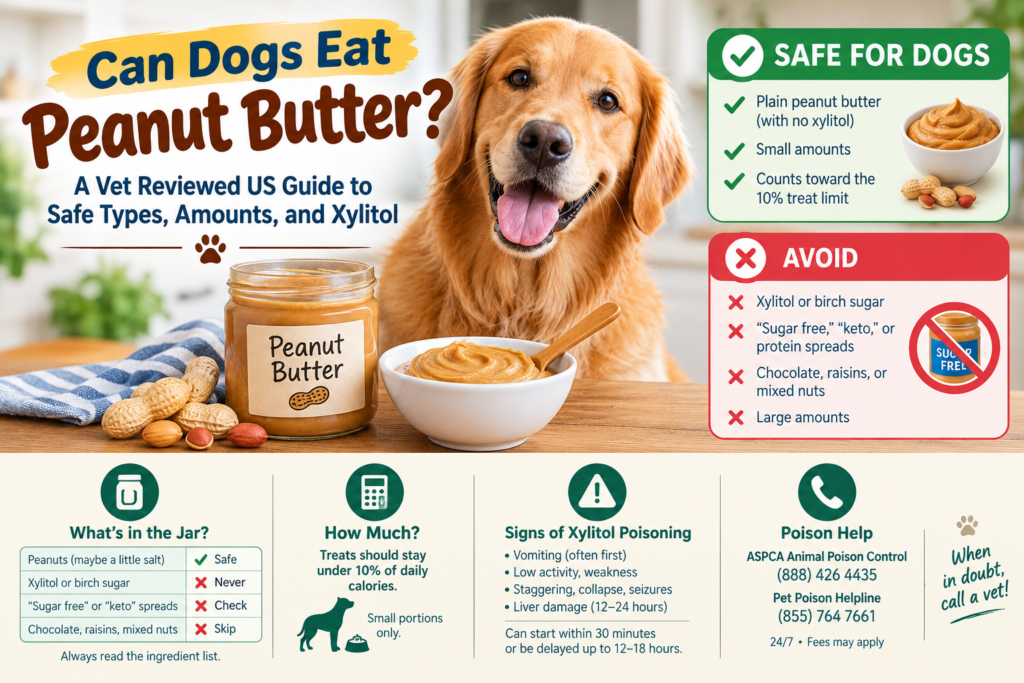
Yes, most dogs can eat plain peanut butter in small amounts. The danger is xylitol, a sweetener (also called birch sugar) that poisons dogs and turns up in some US peanut butters. Read the ingredient list before your dog licks the spoon. If your dog already ate a product with xylitol, call your vet or a poison hotline right now.
Key points
- Plain peanut butter is safe for most dogs when the portion is small.
- Xylitol is the one ingredient that turns a jar into an emergency.
- Treats, peanut butter included, should stay under 10 percent of a dog’s daily calories.
- Dogs with pancreatitis or kidney disease need a vet’s okay first.
- Save the two poison hotline numbers in your phone today.
Quick answer: can dogs eat peanut butter?
Dogs can eat peanut butter when the label is clean, and the portion is small. Plain peanut butter is not a poison. It is packed with fat and calories, so treat it like a treat, not a meal. The jar matters more than the peanuts. Read the label every time, even on a brand you have bought for years, because makers change recipes.
| What Is in the Jar | Verdict | Why |
|---|---|---|
| Peanuts, maybe a little salt | Safe in small amounts | Counts toward the treat limit |
| Xylitol or birch sugar | Never. Call for help | Poisons dogs |
| “Sugar free,” “protein,” or “keto” spreads | Check the label first | Some use xylitol |
| Chocolate, raisins, or mixed nuts | Skip | Toxic or too fatty |
| Large amounts of any peanut butter | Use caution | Fat, calories, salt |
Did your dog eat peanut butter with xylitol? Do this first
Act fast, even if your dog looks fine. It can be 2 a.m. on a Sunday, and help is still a phone call away.
- Grab the jar. Keep the label. Your vet will want the brand and the ingredient list.
- Call your regular vet or the nearest 24-hour ER vet. Tell them you are on the way.
- Or call a poison hotline. ASPCA Animal Poison Control: (888) 426- 4435. Pet Poison Helpline: (855) 764- 7661. Both answer around the clock. A fee applies. Pet Poison Helpline lists $89 per incident on its site, and the ASPCA says a consultation fee may apply, so check current prices.
- Do not make your dog vomit at home unless a vet tells you to. The Merck Veterinary Manual says vomiting should be tried only under vet supervision, and only in dogs that still act normal, because signs can start fast.
- Have your facts ready: the brand, the ingredients, how much your dog ate, your dog’s weight, and the time it happened.
Dogs treated early usually do well. A published review of xylitol poisoning in dogs says the outlook is good for simple low blood sugar and guarded to poor once severe liver damage sets in. That is why a fast call matters.
Why xylitol is dangerous for dogs
In people, xylitol does not cause a big insulin spike. In dogs,s it does. The FDA explains that dogs absorb xylitol quickly, and it can set off a strong release of insulin from the pancreas. Blood sugar then drops fast, and without treatment that drop can be life-threatening. The FDA has also listed some peanut and nut butters among products linked to dog poisonings.
Signs and timing
- Vomiting usually comes first. Low activity, weakness, staggering, collapse, and seizures follow, according to the FDA.
- Low blood sugar can start within 30 minutes. The Merck Veterinary Manual says it can also be delayed up to 12 to 18 hours.
- Liver damage can follow. The ASPCA says it can appear within 12 to 24 hours and can cause abnormal bleeding. Merck adds that some dogs get liver injury without ever showing low blood sugar.
A dog that seems fine an hour later can still need care.
How much xylitol is too much?
Merck reports that doses above about 100 mg per kilogram (45 mg per pound) have been linked to low blood sugar. Above 500 mg per kilogram (227 mg per pound), some dogs develop severe liver injury. Here is what that looks like:
“`html| Dog’s Weight | Low Blood Sugar Risk Above | Liver Risk Above |
|---|---|---|
| 10 pounds | 0.45 grams | 2.3 grams |
| 30 pounds | 1.35 grams | 6.8 grams |
| 70 pounds | 3.2 grams | 15.9 grams |
These are warning lines, not safe amounts. Jar labels rarely list grams of xylitol, so you cannot do this math at home. Treat any xylitol exposure as an emergency.
How to spot xylitol on a label
Look in the ingredient list for these names:
- Xylitol
- Birch sugar
- Birch bark extract
- Any word that starts with “xyl”
Be careful with “sugar free,” “no sugar added,” “low sugar,” “keto,” and “protein” claims. The NC State College of Veterinary Medicine has named brands reported to contain xylitol: Go Nuts, Hank’s Protein Plus, Krush Nutrition, Nuts ’n More, and P28. Recipes change, so the label is your proof, not a brand list. The FDA also notes that xylitol shows up in gum, mints, some baked goods, toothpaste, mouthwash, and chewable vitamins.
Can all dogs eat peanut butter? Who should skip it
Can dogs with pancreatitis eat peanut butter?
Usually not, unless your vet says yes. The Merck Veterinary Manual lists eating trash, large amounts of table scraps, or other wrong foods as a common risk factor for pancreatitis in dogs. Milder cases are switched to a low-fat diet and low-fat treats. USDA data puts about 16 grams of fat in 2 tablespoons of smooth peanut butter.
Can dogs with kidney disease eat peanut butter?
Ask your vet first. Tufts University’s nutrition team says kidney diets limit phosphorus, protein, and sodium. For most dogs with kidney disease, they suggest treats with under 150 mg of phosphorus and 100 mg of sodium per 100 calories. Phosphorus is not on pet treat labels, so your vet has to help with that check.
Diabetes, extra weight, and allergies
Overweight and diabetic dogs need a vet’s plan for every extra calorie, and sweetened jars add sugar on top. A true peanut allergy looks uncommon. The Merck Veterinary Manual lists beef, dairy, chicken, wheat, and lamb as the most common food allergens in dogs, and peanut is not on that list. Still, itching, ear trouble, paw licking, or an upset stomach after a new food is a reason to stop and call your vet.
Puppies and senior dogs
Start with a lick and watch for loose stool. Ask your vet before it becomes a habit. Puppies need a complete puppy food, and treats still fall under the 10 percent limit.
What kind of peanut butter can dogs eat?
The best pick has a short list: peanuts and maybe a pinch of salt. That answers what peanut butter dogs can eat, and what type of peanut butter dogs can eat. Use this checklist in the aisle at Walmart, Target, Kroger, or Costco. It sorts out the peanut butter dogs can eat from the jars to leave on the shelf.
- No xylitol or birch sugar.
- No chocolate, raisins, or macadamia nuts.
- Little or no added sugar.
- Low salt. The ASPCA says large amounts of salt can cause thirst, vomiting, tremors, and seizures.
- A clean smell and no mold.
Can dogs eat regular peanut butter, or human peanut butter?
Yes. Regular human peanut butter from the grocery aisle is fine when the label has no xylitol, and the portion is small. Most big jars add some sugar, salt, or oil, so lean toward the plainest one.
Can dogs eat natural or organic peanut butter?
Often yes, but “natural” and “organic” describe how the food is made. They do not promise the jar is free of xylitol, so whether dogs can eat natural peanut butter and whether dogs can eat organic peanut butter both come down to the label. Stir natural jars well. The oil that rises to the top adds fat.
What about palm oil in peanut butter?
Many jars use palm oil to keep the oil from separating. The ASPCA’s list of foods to avoid does not name palm oil, but it is still fat. It adds calories, and it matters for dogs with pancreatitis. So peanut butter with palm oil is fine for most healthy dogs in small amounts.
Nutrition facts that make portions easy
USDA FoodData Central lists about 190 calories and 16 grams of fat in 2 tablespoons of smooth peanut butter. That works out to about 95 calories per tablespoon and about 32 calories per teaspoon. Keep that number handy for the portion math below.
| Brand | What We Found | Your Move |
|---|---|---|
| Jif | The maker’s FAQ says Jif peanut butter products do not contain xylitol. | Still read the label. |
| Skippy | The maker told a shopper on a retailer site that SKIPPY products do not contain xylitol. | Check your jar. |
| Peter Pan | No public xylitol statement found. | The label is your proof. |
| Store brands | No brand-level proof. | Read the label. |
Can dogs eat Jif peanut butter?
Yes, in small amounts. Jif says its products have no xylitol, and that includes Jif creamy peanut butter. Some people search for “Jiffy,” but the brand is spelled Jif, and its site says it has used that name since 1958. So can dogs eat Jiffy peanut butter? The answer is the same. Check the label for added sugar and salt.
Can dogs eat Skippy peanut butter?
The maker says no xylitol, and that covers Skippy creamy peanut butter. Look at the sugar and salt on your jar, since both count against your dog.
Can dogs eat Peter Pan peanut butter?
Peter Pan is a common US brand, and we found no public xylitol statement. Standard jars list their ingredients, so read yours.
Can dogs eat crunchy peanut butter? Chunky, creamy, and nuts
Yes. Crunchy, chunky, and creamy peanut butter are all fine when the jar has no xylitol. Texture is the only difference. Pieces can be a choking risk for very small dogs, so smooth is easier on puppies and tiny breeds.
Can dogs eat peanut butter with nuts?
Mixed nut spreads need care. The ASPCA says macadamia nuts can cause weakness, vomiting, tremors, and high body temperature in dogs, usually within 12 hours. Almonds, pecans, and walnuts are very fatty, and the ASPCA says they can cause vomiting, diarrhea, and sometimes pancreatitis. Can dogs eat peanuts in peanut butter? Yes. The extra nuts are the problem.
Why can dogs eat peanut butter but not peanuts?
That idea is a myth. The ASPCA’s list of foods to avoid does not include peanuts. Plain peanuts are fine in small amounts. Skip salted, seasoned, and honey-roasted ones, and skip shells.
How much peanut butter can a dog have?
Use the 10 percent rule. Tufts University’s nutrition team says no more than 10 percent of a dog’s calories should come from anything other than the main dog food. The AAHA and WSAVA guidelines agree, and UC Davis uses the same limit.
Tufts gives an example: a 10-pound dog eats about 300 calories a day, so its treat limit is 30 calories. That is about one teaspoon of peanut butter, and it has to cover every treat that day, including chews, training rewards, and the dab you use to hide a pill.
- Find your dog’s daily calories on the food bag or ask your vet.
- Multiply by 0.10. That is the whole treat budget.
- Divide by 32 to see teaspoons of peanut butter.
| Dog Eats per Day | Treat Budget | Peanut Butter if It Used All of It |
|---|---|---|
| 300 calories | 30 calories | About 1 teaspoon |
| 600 calories | 60 calories | About 2 teaspoons |
| 1,200 calories | 120 calories | About 4 teaspoons |
We suggest letting peanut butter use no more than half of the budget, so there is room for other treats.
Can dogs eat peanut butter every day?
A small spoon on most days is fine for a healthy dog when it fits the budget. Daily extras add up, so cut back if your dog is gaining weight. Skip it for dogs with pancreatitis.
Is peanut butter good for dogs? Benefits and risks
Peanut butter gives dogs protein and fat for energy. It is also a high-value reward for training, hiding pills, and filling toys. It does not replace complete dog food. The risks are extra calories, fat, salt, sugar, and xylitol.
| Situation | Signs | What to Do |
|---|---|---|
| Mild stomach upset | Loose stool, gas, or one bout of vomiting after too much | Hold the peanut butter and call your vet if it lasts |
| Emergency | Weakness, staggering, collapse, seizures, or repeated vomiting after any xylitol exposure | Go to an ER vet now and call a poison hotline |
What about foods made with peanut butter?
| Food | Verdict | Main Concern |
|---|---|---|
| Peanut butter and jelly, PB&J sandwich | Skip, or one lick | Sugar, possible xylitol |
| Bread or toast with peanut butter | Small bite only | Calories, xylitol in some baked goods |
| Ritz or Lance peanut butter crackers | Skip | Salt, sugar, refined flour |
| Peanut butter pretzels | Skip | Salt |
| Cookies, fudge, Reese’s | Never | Chocolate, sugar, possible xylitol |
| Apples, bananas, or celery with peanut butter | Yes, small amounts | Count the calories |
| Almond butter | Caution | Fat, possible xylitol |
Can dogs eat peanut butter and jelly sandwiches?
A lick off a crust will not poison most dogs. Still, jelly adds sugar and no benefit. NC State’s veterinary college lists jams and jellies among products that can contain xylitol, and sugar-free jelly is the biggest worry. Grape jelly is another reason to skip it, since the ASPCA warns that grapes and raisins can lead to kidney damage in dogs. Strawberry jelly is not a poison, but it is mostly sugar. So, can dogs eat a peanut butter and jelly sandwich? One bite is unlikely to hurt. Do not make it a habit. The same goes for peanut butter sandwiches and the question of whether dogs can eat jelly and peanut butter together.
Can dogs eat bread or toast with peanut butter?
Plain bread is not a known toxin. Can dogs eat bread with peanut butter, or toast with peanut butter? A thin smear on a small bite is fine. Never give raw bread dough, because the ASPCA says rising yeast dough can swell in the stomach and make alcohol. Raisin bread is out. The FDA warns that xylitol can be in baked goods, so check sugar-free breads.
Can dogs eat Ritz or Lance peanut butter crackers?
One cracker will not poison most dogs, but packaged cracker sandwiches add salt, sugar, and white flour. Read the label for xylitol, then give a bite at most.
Can dogs eat peanut butter pretzels?
The same goes for peanut butter pretzels and peanut butter-filled pretzels. They are salty, and the ASPCA warns that too much salt can make dogs sick. Pick a different treat. If you wonder about pretzels with peanut butter at a cookout, a dropped bit is fine, but do not hand them over on purpose.
Can dogs eat peanut butter cookies, fudge, or Reese’s peanut butter?
No. Chocolate is the main problem. The ASPCA says chocolate can cause vomiting, fast heart rate, tremors, and seizures, and baking chocolate and cocoa powder are the most dangerous. Cookies and fudge also pack sugar and fat, and some sugar-free baked goods use xylitol.
Can dogs eat apples, bananas, or celery with peanut butter?
Yes, these are the best pairings. Can dogs eat apples with peanut butter, or apples and peanut butter? Yes, slice them and remove the core and seeds. Can dogs eat bananas and peanut butter? Yes, in small slices. Can dogs eat celery and peanut butter? Yes, cut the celery into short pieces so it is easy to chew. Count the peanut butter in your dog’s treat budget.
Can dogs eat almond butter instead of peanut butter?
Not a better choice. The ASPCA says almonds are high in fat and can cause vomiting, diarrhea, and sometimes pancreatitis. Check any nut butter for xylitol too.
Fun, safe ways to serve it
- Spread a thin layer on a lick mat.
- Stuff a Kong and freeze it overnight.
- Hide a pill in a small dab, and count it in the treat budget.
- Throw out any jar that smells off or has mold, and follow the storage directions on the label.
Where sources disagree
Pet sites do not agree on peanut butter and jelly, daily use, or serving size. Some allow a lick of jelly, and others say never. Serving charts range from half a teaspoon to a tablespoon a day. The calorie method above fits your own dog, so we use it.
Frequently asked questions
Can dogs eat peanut butter safely?
Yes, when the jar has no xylitol, the portion is small, and your dog does not have pancreatitis, kidney disease, or a weight problem your vet is managing.
How fast do xylitol signs show up?
Low blood sugar can start within 30 minutes or be delayed up to 12 to 18 hours, says the Merck Veterinary Manual. Liver damage can show within 12 to 24 hours, says the ASPCA.
Is xylitol common in peanut butter?
Only some brands use it, often “protein” or “sugar-free” spreads. The FDA still lists some peanut and nut butters among xylitol sources, so check every jar.
Can I hide a pill in peanut butter?
Yes, with a xylitol-free jar. Use a small dab and count it toward the 10 percent limit.
The bottom line
Plain, xylitol-free peanut butter is a safe treat for most dogs in small amounts. Check the label, keep portions to your dog’s treat budget, and skip it if your vet has put your dog on a low-fat or kidney diet. If your dog eats xylitol, treat it as an emergency: call your vet, the ASPCA at (888) 426- 4435, or Pet Poison Helpline at (855) 764 7661.
How we wrote this
We checked each health claim against the FDA, ASPCA, Merck Veterinary Manual, Tufts University, UC Davis, NC State, and USDA. A licensed veterinarian reviewed the article. Brand and hotline details were last checked on October 29, 2026.
References
- FDA: Paws Off Xylitol; It’s Dangerous for Dogs
- Merck Veterinary Manual: Xylitol Toxicosis in Dogs
- Xylitol toxicity in dogs, published review (PubMed)
- ASPCA: People Foods to Avoid Feeding Your Pets
- ASPCA Animal Poison Control
- Pet Poison Helpline
- NC State College of Veterinary Medicine: Xylitol
- Tufts Cummings School: treats and the 10 percent rule
- Tufts Cummings School: treats for dogs with kidney disease
- UC Davis Veterinary Medicine: Treat guidelines for dogs
- AAHA and WSAVA treat guidance, discussed in PubMed Central
- Merck Veterinary Manual: Pancreatitis in dogs
- Merck Veterinary Manual: Food allergy overview
- USDA FoodData Central
- Jif FAQ
Written By Dr. Lorenzo Bertelli
Dr. Lorenzo Bertelli, DVM, is a veterinarian with 5+ years of experience in small animal medicine, specializing in canine nutrition and preventive care. A graduate of the University of Florida, he writes to help dog owners make confident, informed feeding decisions. He shares his home with two dogs, Zeus and Rocky.
Reviewed By Dr. Lara Friedman, DVM
Dr. Lara Friedman, DVM, is a veterinarian with 6+ years of experience across hospital, clinic, and shelter medicine, specializing in canine nutrition and preventive care. A graduate of Colorado State University and a Fear Free Certified Professional®, she writes to help dog owners prevent diet-related health issues before they start. She shares her home with her dog, Duke.