Can Dogs Eat Mango? Vet-Reviewed Guide to Skin, Seeds, Dried, Frozen, and Safe Amounts

By Dr. Bradley Pierson, DVM. Reviewed By Dr. Lorenzo Bertelli
Published: 16 October, 2026
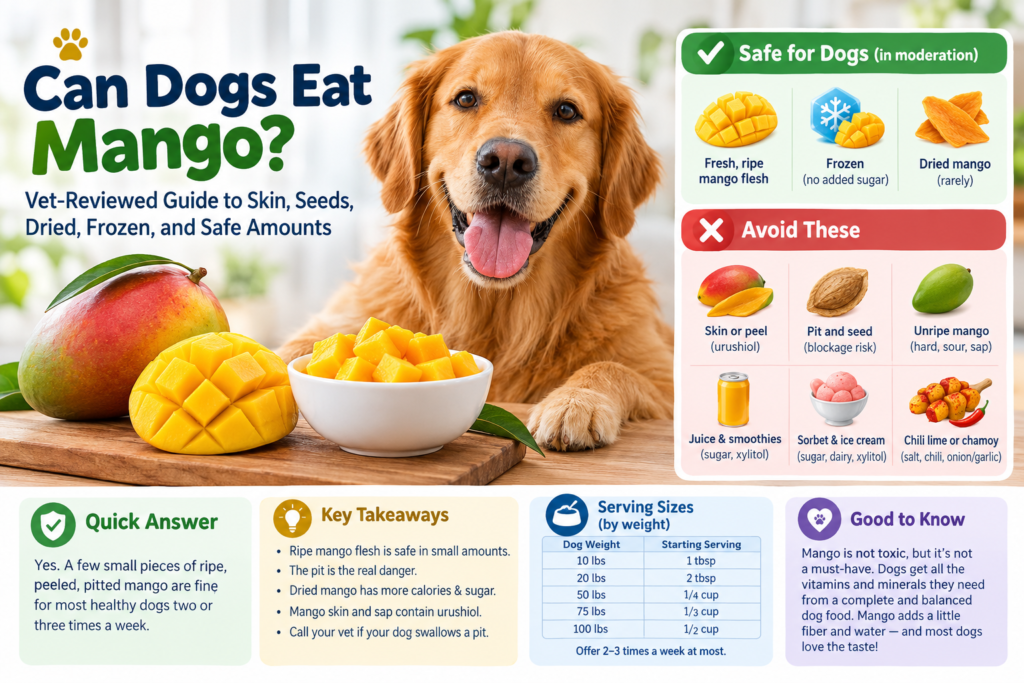
Yes, dogs can eat mango. Peeled, pitted, ripe flesh is a safe treat for most healthy dogs in small amounts. The big dangers are the pit, which can block the gut, and too much sugar at once. Skin, dried mango, and seasoned mango need extra care. Below you will find serving sizes by weight in pounds and cups, plus what to do if your dog swallows a pit.
Quick Answer
Yes. A few small pieces of ripe, peeled, pitted mango are fine for most healthy dogs two or three times a week. Take out the pit and skin first. Skip dried, sweetened, and seasoned mango, and keep all treats under 10% of daily calories. Ask your vet first if your dog has diabetes or a sensitive stomach.
More about can dogs eat fruits
Key Takeaways
- Ripe mango flesh is safe in small amounts. A cup of chunks has about 99 calories and 23 grams of sugar.
- The pit is the real danger. A swallowed pit can block the throat or intestines.
- Dried mango has about five times the calories and sugar of fresh, so it is not an even swap.
- Mango skin and sap contain urushiol, the same irritant family as poison ivy.
- If your dog swallows a pit, call your vet or Pet Poison Helpline at (855) 764- 7661.
Can Dogs Eat Mango? The Short Answer
Yes, in small amounts. Mango flesh is not toxic to dogs. It is soft, sweet, and low in fat, which makes it an easy treat. It is also high in natural sugar, so it works best as an occasional snack, not a daily habit. The Merck Veterinary Manual advises keeping treats of every kind under 10% of a dog’s daily calories. Your dog’s regular food should supply the rest.
Is mango toxic to dogs?
No. The ripe flesh is not poisonous. The risks come from the pit, from large amounts of sugar and fiber, and from added ingredients in products like dried mango, juice, and seasoned mango.
Can Dogs Eat Mangoes? Which Forms Are Safe
Yes. The same rules apply to every ripe mango at a US grocery store, including the Tommy Atkins and Ataulfo types listed by USDA. We found no variety that is unsafe for dogs. The form matters more than the type.
| Form | Safe for Dogs? | What to Watch |
|---|---|---|
| Fresh, ripe flesh | Yes, small amounts | Sugar and portion size |
| Skin or peel | No | Urushiol and tough fiber |
| Pit and seed | No | Blockage and choking |
| Unripe green mango | Skip | Hard, sour, sap |
| Frozen, no added sugar | Yes, thawed and chopped | Hard chunks |
| Dried or freeze-dried | Rarely | Sugar, calories, sulfites |
| Canned in syrup | No | Added sugar |
| Juice and smoothies | No | Sugar and xylitol |
| Sorbet and ice cream | No | Sugar, dairy, xylitol |
| Chili lime or chamoy mango | No | Salt, chili, hidden onion or garlic |
Is Mango Good for Dogs? What the USDA Data Shows
It is a decent snack, but dogs do not need it. USDA FoodData Central lists raw mango at about 60 calories, 13.7 grams of sugar, 1.6 grams of fiber, and 36 milligrams of vitamin C per 100 grams. A cup of chunks weighs about 165 grams. That cup holds about 99 calories and 23 grams of sugar.
Dogs make their own vitamin C, so they do not need it from fruit. A complete and balanced dog food already covers their vitamins and minerals. Mango adds a little fiber and water, and most dogs love the taste. That is about all. Claims that mango fights disease in dogs come from human and lab research, not dog studies.
How Much Mango Can a Dog Eat? Serving Sizes by Weight
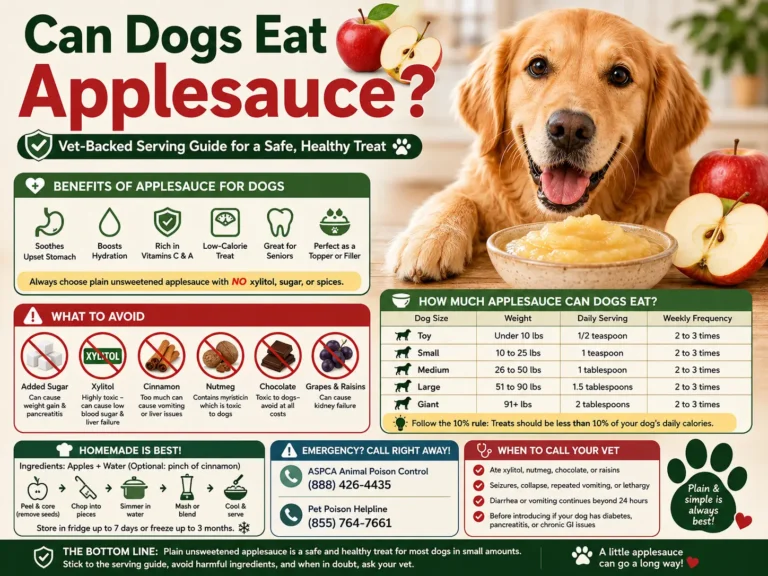
No dog study sets an exact dose, and guides online disagree by a wide margin. Some give a 10-pound dog a tablespoon. Others give it a quarter cup. Some let a big dog have a full cup, which is about 99 calories. These starting amounts aim for about one fifth of your dog’s daily treat budget. That leaves room for other treats and keeps sugar low.
| Dog Weight | Starting Serving (Diced and Plain) | Calories | Sugar | Share of Treat Budget |
|---|---|---|---|---|
| 10 lbs | 1 tablespoon | About 6 | 1.4 g | 18% |
| 20 lbs | 2 tablespoons | About 12 | 2.8 g | 21% |
| 50 lbs | 1/4 cup | About 25 | 5.6 g | 21% |
| 75 lbs | 1/3 cup | About 33 | 7.5 g | 21% |
| 100 lbs | 1/2 cup | About 50 | 11 g | 25% |
Serving tip: Offer plain, diced mango two or three times a week at most. Keep all treats combined under 10% of your dog’s daily calories.
Offer it two or three times a week at most.
The calorie math
Vets estimate a dog’s resting calories with this formula: 70 times body weight in kilograms, raised to the 0.75 power. A review in PubMed Central lays it out. A common estimate for a neutered adult is 1.6 times that number.
A 50-pound dog is 22.7 kilograms. That works out to about 730 resting calories and roughly 1,160 calories a day. Ten percent of that is about 115 calories for all treats combined. A quarter cup of mango uses about 25 of them.
Can Dogs Eat Mango Slices? How to Cut and Serve
Yes, if the slices are peeled and cut small. Whole slices are a choking risk, especially for small dogs.
- Wash the whole mango under running water. The knife can drag residue from the skin into the flesh.
- Peel it. Wear gloves if you react to poison ivy.
- Cut the flesh away from the pit in slices about a quarter inch thick.
- Dice the slices into cubes smaller than your dog’s mouth. Think the size of a dime for small dogs and a nickel for big dogs.
- Offer one piece first and wait a few hours before giving more.
Check store-bought cut mango cups for syrup or added sugar. Plain fresh cut fruit is fine.
Can Dogs Eat Mango Skin? Urushiol Explained
No. Skip the skin. It is tough to chew and hard to digest, and it holds the most urushiol. Urushiol is the oil behind the poison ivy rash. Mango belongs to the same plant family, called Anacardiaceae, which also includes cashews.
A review in PubMed Central found that mango rashes in people can come from the fruit, peel, stem, sap, or the tree itself, though cases are rare. That research is in people. We found no dog study that measures how often mango skin causes a reaction in dogs. The skin has no nutritional upside and can upset a dog’s stomach, so peel it. Wash your hands and your cutting board afterward.
Can Dogs Eat Mango Seeds? Pit, Seed, Cyanide, and Blockage Risk
No. Take out the pit every time. The pit, also called the stone, is the hard shell. The seed, or kernel, sits inside it. Both cause trouble, in two different ways.
Blockage comes first. A mango pit can be several inches long. That is big enough to lodge in a dog’s throat, esophagus, or intestines. This is the most likely danger.
Cyanide comes second. Many plant seeds contain compounds that release cyanide. The Merck Veterinary Manual says seeds and leaves usually hold more of these compounds than the fleshy part of fruit. Pet Poison Helpline says cyanide may be released if a pit is chewed and crushed. If a dog swallows a pit whole and unbroken, the group says poisoning is not expected, though stomach upset and a blockage are possible.
We found no study that measures the cyanide in a mango pit for dogs. So treat the pit as a blockage risk first and a chemical risk second. A dog that cracked the pit open needs a call to the vet right away.
Can Dogs Eat Dried Mango? Sugar Numbers and a Label Checklist
Rarely, and not as a regular treat. Drying removes water but leaves the sugar, so dried mango is far denser than fresh. USDA FoodData Central lists sweetened dried mango at about 319 calories and 66 grams of sugar per 100 grams. Fresh mango has about 60 calories and 14 grams of sugar. That is about five times the calories and nearly five times the sugar.
Here is what that means in a real treat budget. A 10-pound dog’s treat budget is about 35 calories. That is only 11 grams of sweetened dried mango, about one small piece. A 50-pound dog’s budget of about 115 calories is about 36 grams, a little over an ounce. Dried mango is also sticky, so it clings to teeth.
Sulfites are one more reason to read the label. Many dried fruits are treated with sulfur dioxide to keep their color. It is allowed in food at set limits, but it can bother sensitive people. We found no dog study on sulfites in dried mango, so skip any bag that lists sulfur dioxide or sulfites.
Check the label for:
- the word “sweetened,” or any added sugar, syrup, or juice concentrate
- sulfur dioxide, sulfites, or E220
- sugar-free sweeteners, especially xylitol, which the ASPCA says to keep away from dogs
- chili, lime, salt, garlic powder, or onion powder
- chocolate or yogurt coatings
If the only ingredient is mango, a small piece is the best case. Homemade dried slices have no additives but still pack concentrated sugar. Freeze-dried mango is just as concentrated by weight.
Can Dogs Eat Frozen Mango?
Yes, if it is plain. Frozen mango chunks with no added sugar have about the same calories as fresh. The problem is texture. Frozen chunks are hard, which makes them a choking risk and can hurt teeth. Thaw them for a few minutes or chop them small before serving. Read the bag and skip any that list sugar, syrup, or juice.
Can Dogs Eat Unripe, Overripe, or Fallen Mango?
Skip all three. Green mango is hard and sour, which makes it harder to chew and digest, and mango sap can irritate skin. We found no dog studies on green mango. Overripe mango is a problem too, because rotting fruit can grow mold and ferment. Throw out any mango that is mushy, leaking, or fuzzy.
If you live in Florida, Texas, California, or Hawaii and have a mango tree, pick up fallen fruit every day. Dogs find mangoes in the grass and swallow them pit and all.
Can Dogs Have Mango Juice, Smoothies, Sorbet, or Chili Lime Mango?
No to all of these.
- Juice and smoothies: sugar without the fiber, and many have added sweeteners.
- Sorbet and ice cream: sugar and dairy. Sugar-free versions can contain xylitol.
- Chili lime mango: street-style mango with chili lime seasoning or chamoy brings salt, chili, and often sugar.
- Mango salsa: onion, which the ASPCA says can damage a dog’s red blood cells.
Always read the label on seasonings and sauces. Some blends list garlic or onion powder.
Can Puppies Eat Mango?
A tiny piece of ripe, peeled, pitted mango is usually fine once a puppy eats solid food. Puppy stomachs are sensitive, and guides disagree on when to start, so ask your vet at the next visit. Use half the amounts in the table and skip dried mango.
Which Dogs Should Skip Mango?
Ask your vet before offering mango if your dog:
- has diabetes, since raw mango has about 14 grams of sugar per 100 grams
- is overweight or on a weight loss plan
- has had pancreatitis. Mango is low in fat, with about 0.4 grams per 100 grams, so it is not a classic trigger, but any new treat should fit the care plan
- has a sensitive stomach, colitis, or frequent diarrhea
- eats a prescription or vet-planned diet
- has ever had a food allergy
How Often Can Dogs Have Mango?
Two or three times a week is a safe start. Watch the stool. Mango has sugar and fiber, and both can loosen it. If your dog does well for a week, keep that routine. Skip mango on days when your dog has already had other sweet treats.
My Dog Ate a Mango Pit. What Should I Do?
Stay calm and act the same day.
- Take away anything left, and note whether the pit was swallowed whole or chewed.
- Call your vet or an emergency animal hospital. Tell them your dog’s weight, the size of the pit, and when it happened.
- Do not try to make your dog vomit unless a vet tells you to.
- For poison questions, call the ASPCA Animal Poison Control Center at (888) 426- 4435 or Pet Poison Helpline at (855)764- 76611. Both are open around the clock, and a fee applies.
Watch for signs of a blockage: repeated vomiting, no interest in food, belly pain or swelling, straining or no stool, drooling or gagging, and sudden tiredness. These can show up within hours. The Texas A&M University College of Veterinary Medicine notes that some food problems take up to a day to show, so keep watching for at least 24 hours.
If your dog chewed the pit, watch for trouble breathing, wide pupils, or bright red gums. Pet Poison Helpline lists these as signs of cyanide poisoning. They are an emergency.
Can Dogs Be Allergic to Mango, and Why Does It Cause Diarrhea?
Allergies are rare. Signs of a food allergy in dogs include itchy skin, ear infections, paw licking, vomiting, or diarrhea. In people, mango reactions are mostly rashes from skin contact. If you see a pattern after mango, stop it and call your vet. Swelling of the face or trouble breathing is an emergency.
Diarrhea is far more common, and it is usually not an allergy. A big serving brings a lot of sugar and fiber at once, and both can loosen stool. Smaller portions fix it for most dogs.
More Questions Dog Owners Ask
Can diabetic dogs eat mango? Ask your vet first. Raw mango has about 14 grams of sugar per 100 grams, and any treat should fit your dog’s diabetes plan.
Does mango clean a dog’s teeth? We found no evidence that it does. Dried mango can stick to teeth. Brushing and regular vet dental care work better.
Is mango better than other fruit? It is not better or worse. It is sweeter than many fruits, so the serving sizes above matter.
Is Mango Safe for Dogs? The Bottom Line
Ripe, peeled, pitted mango is a safe, tasty treat for most dogs in small amounts. Take out the pit and skin, skip dried and seasoned mango, and use the serving sizes above. Call your vet if your dog swallows a pit. For more safe snack ideas, read our guides on broccoli and oranges.
This article is general information and does not replace advice from your veterinarian. If your dog shows signs of illness or ate something you are unsure about, call your vet, the ASPCA Animal Poison Control Center at (888) 426- 4435, or Pet Poison Helpline at (855)764- 76611.
Read more of our articles:
Sources
- ASPCA Animal Poison Control Center, People Foods safe and unsafe list and poison control hotline
- Pet Poison Helpline, Cherry (Prunus) poison entry on pits, chewing, and obstruction
- Merck Veterinary Manual, small animal feeding guidance on treats and daily calories
- Merck Veterinary Manual, Cyanide Poisoning in Animals
- USDA FoodData Central, entries for raw mango, Tommy Atkins mango, Ataulfo mango, and sweetened dried mango
- PubMed Central (NIH), Contact Allergy Induced by Mango (Mangifera indica): A Relevant Topic, PMC8621529
- PubMed Central (NIH), Retrospective Study of Energy Requirement Recommendations for Dogs in a Brazilian Veterinary Hospital, PMC12345587
- Texas A&M University College of Veterinary Medicine and Biomedical Sciences, The Dos and Don’ts of Feeding Pets People Food
Written By Dr. Bradley Pierson, DVM
Dr. Bradley Pierson, DVM, is a veterinarian with 15+ years of experience in small animal medicine, specializing in internal medicine and preventive care. A graduate of the University of Illinois and Fear Free Certified Professional, she writes to help dog owners navigate food safety at every life stage. She has also volunteered extensively in dog shelter care.

Reviewed By Dr. Lorenzo Bertelli
Dr. Lorenzo Bertelli is a licensed veterinarian with over five years of experience in small animal medicine. He earned his Doctor of Veterinary Medicine (DVM) degree from the University of Florida College of Veterinary Medicine and has built his career in small animal general practice, caring for dogs at every stage of life. His clinical work includes preventive medicine, digestive disorders, food allergies, nutritional counseling, and diagnosing and treating food-related illnesses.