Can Dogs Eat Grapes? Vet-Sourced Answer, Signs of Toxicity & What to Do

By Dr. Grace Mullen, DVM Reviewed By Dr. Bradley Pierson, DVM
Published: 9 July, 2026
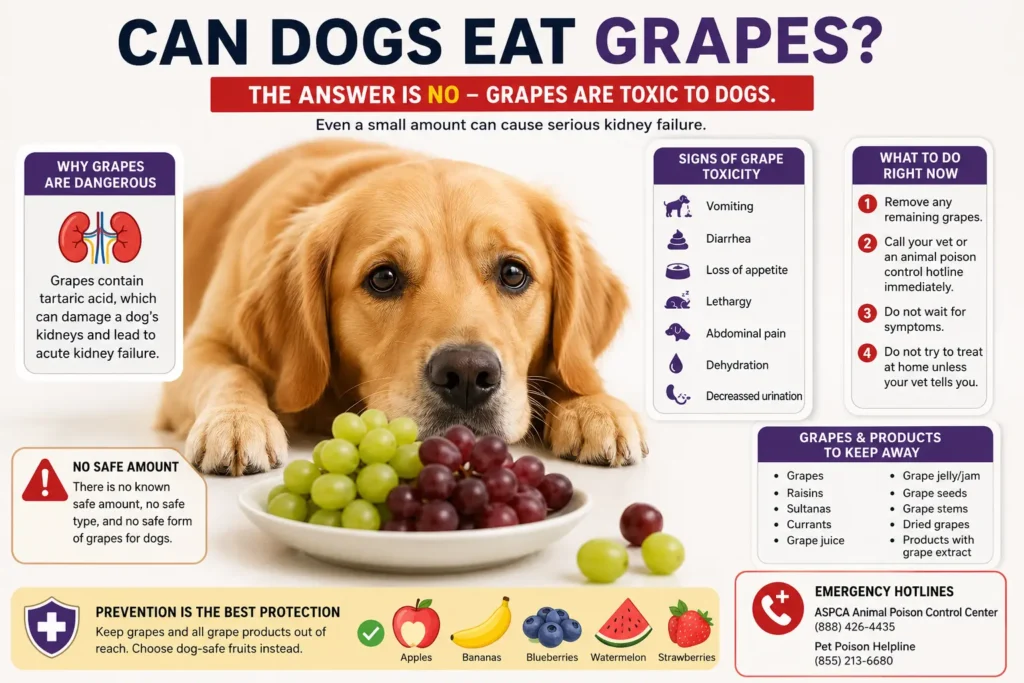
No, dogs cannot eat grapes. Grapes are toxic to dogs,s and even a small amount can trigger sudden kidney failure. There is no known safe amount, no safe type, and no safe form. If your dog just ate a grape, call your veterinarian or an animal poison control hotline right now. Keep reading for the full picture on symptoms, timing, treatment, and every grape product you might be wondering about.
Are Grapes Actually That Bad for Dogs?
Yes. This is not internet exaggeration. Grapes are one of the most common causes of sudden kidney failure in dogs seen by veterinary emergency rooms across the United States. The Cornell University College of Veterinary Medicine lists grapes, raisins, sultanas, and Zante currants as a direct cause of acute kidney injury in dogs, and warns that any ingestion should be treated as a medical emergency.
Here is what makes grapes unusual compared to other risky foods. With most toxins, a bigger dog can safely handle a bigger amount. Grapes do not follow that rule. Veterinary researchers have documented cases where a single grape made one dog seriously ill while another dog ate a whole bunch with no symptoms at all. Because there is no way to predict which dog will react, every veterinary source treats every exposure the same way: as an emergency, regardless of the dog’s size, breed, or history with grapes.
Why Are Grapes Toxic to Dogs? The Science Behind It
For more than twenty years, veterinarians knew grapes could poison dogs but did not know why. That changed in 2021, when researchers connected a case involving homemade play dough made with cream of tartar to the same kidney damage pattern seen in grape poisoning cases. Cream of tartar is a purified form of tartaric acid, a natural acid found in high concentrations in grapes.
A team of veterinary toxicologists published their findings in the Journal of the American Veterinary Medical Association, proposing tartaric acid as the likely toxic component in grapes. A follow-up study in the Journal of Veterinary Emergency and Critical Care in 2022 strengthened the connection further, after several dogs developed the same kind of kidney injury from eating cream of tartar or tamarinds, which also contain tartaric acid.
Dogs appear to process tartaric acid poorly. The compound builds up in the small tubes inside the kidney that filter waste from the blood, damaging them faster than the kidney can repair itself. This is still an active area of research, and the exact mechanism is not fully settled. That honesty matters more than false certainty. What is settled, according to the Merck Veterinary Manual, is that the tartaric acid content of grapes and raisins varies from fruit to fruit, which helps explain why reactions are so unpredictable from one dog to the next.
Vet Said Grapes Are Fine for My Dog? Here’s What to Know
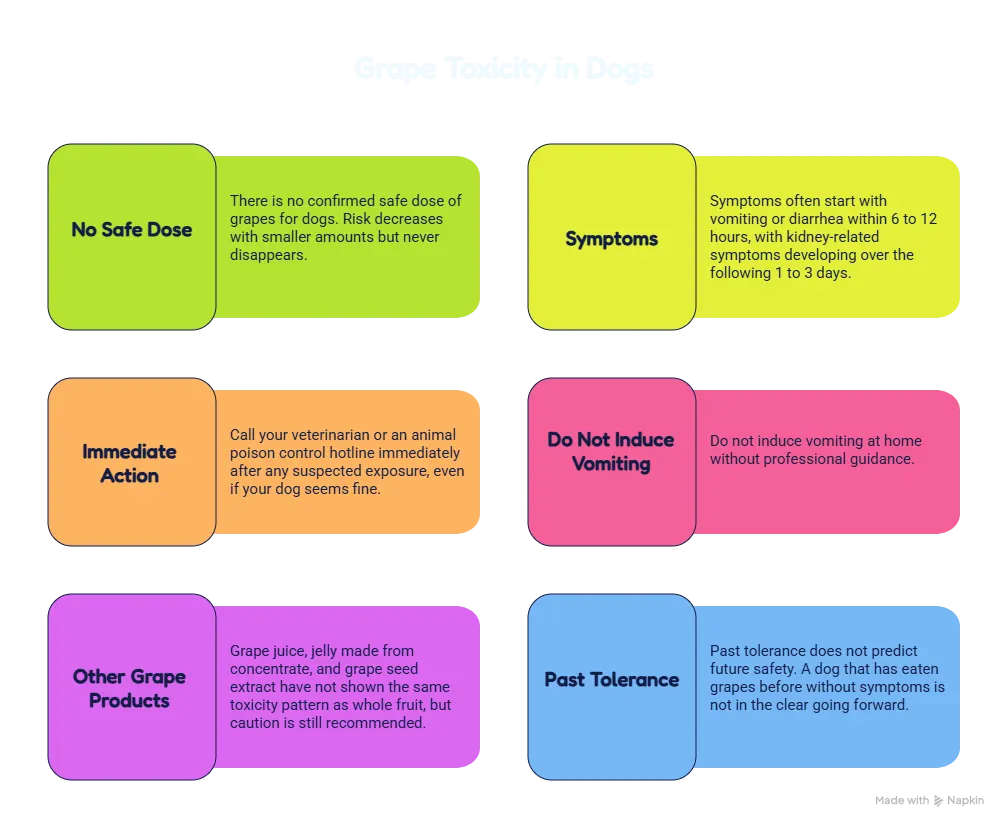
If you have heard this from someone, it is worth checking directly with your own veterinarian before assuming it is accurate advice for your dog. No major U.S. veterinary authority, including Cornell, the Merck Veterinary Manual, or the ASPCA, currently lists grapes as safe for dogs in any amount. Some dogs have eaten grapes repeatedly with no visible reaction, and that history sometimes gets passed along as reassurance. But tolerance in the past does not predict safety in the future, and no vet school or toxicology center recommends feeding grapes on purpose.
How Many Grapes Are Dangerous? Dosage by Dog Weight
There is no officially confirmed safe amount of grapes for any dog. The Merck Veterinary Manual notes that more than one grape or raisin per 10 pounds of body weight may contain enough tartaric acid to put a dog at risk of kidney damage. That works out to roughly the following, though these numbers are meant as a general risk guide, not a safety threshold.
| Dog’s Weight | Approximate Risk Point | What This Means |
|---|---|---|
| 5 lbs (Chihuahua, teacup breeds) | Less than 1 grape | Even one grape can be enough to cause illness. |
| 10 lbs (Small Terrier, toy breeds) | About 1 grape | Treat any amount as a veterinary emergency. |
| 25 lbs (Beagle, Corgi) | About 2–3 grapes | The risk of poisoning increases quickly as more grapes are eaten. |
| 50 lbs (Border Collie, Bulldog) | About 5 grapes | Still considered a medical emergency and requires immediate veterinary care. |
| 90+ lbs (Labrador, German Shepherd) | About 9 grapes | Larger body size does not eliminate the risk of grape toxicity. |
Is one grape enough to hurt a dog?
Yes, for some dogs. A small number of documented cases show kidney injury after a dog ate only four or five grapes, and toy breed dogs have become seriously ill after eating just one. Because there is no way to know in advance whether your dog is one of the sensitive ones, treat any amount, even a single grape, as a reason to call your vet.
How many grapes are too many for a dog?
Functionally, any number. Veterinary toxicologists have not been able to establish a dose that is guaranteed safe, so the practical rule used by emergency vets across the country is simple: if a dog ate a grape, it is a call to the vet, not a wait-and-see situation.
Signs of Grape Toxicity in Dogs
Grape poisoning does not look the same in every dog, and symptoms often appear in stages. Knowing the general timeline can help you understand what your vet is watching for.
| Time After Eating Grapes | What You May See |
|---|---|
| 0 to 6 hours | Vomiting (sometimes with grape or raisin pieces visible), drooling, and mild stomach discomfort. |
| 6 to 24 hours | Diarrhea, loss of appetite, tiredness, abdominal pain, and increased thirst or urination. |
| 24 to 72 hours | Reduced or no urination, extreme thirst, weakness, bad-smelling breath, and tremors in severe cases. |
How bad are grapes for dogs once symptoms start?
The early symptoms can look like ordinary stomach upset, which is part of what makes grape poisoning dangerous. It is easy to assume a dog just has an upset stomach from something else. The signs that show up later, especially reduced urination and extreme lethargy, usually mean the kidneys have already started to shut down, which is a much harder stage to treat.
Can grapes kill a dog?
Yes. Left untreated, grape toxicity can progress to acute kidney failure, which can be fatal. A widely cited study published in the Journal of Veterinary Internal Medicine reviewed 43 dogs that developed kidney injury after eating grapes or raisins and found that among the dogs that progressed to kidney failure, close to half did not survive. That same research also found that dogs who received prompt treatment before kidney damage set in had significantly better outcomes. Timing genuinely changes the outcome here.
How long does it take for grape poisoning symptoms to show?
Early digestive symptoms often begin within 6 to 12 hours, according to the Merck Veterinary Manual. Kidney-related symptoms typically develop within 72 hours, though VCA Animal Hospitals notes that early bloodwork can look normal even when kidney damage is already starting, which is why vets often recommend repeat testing over several days rather than a single blood test.
What to Do If Your Dog Eats Grapes
Stay calm and act fast.
Do not wait for symptoms to appear before reaching out for help.
- Call your veterinarian immediately. If it is after hours, call an emergency animal hospital.
- If you cannot reach a vet, call an animal poison control hotline. The ASPCA Animal Poison Control Center is available at (888) 426-4435, and Pet Poison Helpline is available at (855) 764-7661. Both operate 24 hours a day, every day of the year, and both charge a consultation fee, but the guidance can prevent a far more expensive emergency later.
- Do not try to make your dog vomit at home without instruction. Inducing vomiting incorrectly, or in a dog that is having trouble breathing, drooling heavily, or already showing signs of distress, can cause more harm. This step should only be done under direct guidance from a vet or poison control specialist.
- Gather details before you call. Your dog’s weight, roughly how many grapes or how much of a grape product was eaten, and how long ago it happened all help the vet make faster decisions.
Not Sure If Your Dog Actually Ate a Grape?
This happens more often than you might think. Maybe you found an empty stem on the kitchen floor, or a bowl of grapes looks lower than you remember. When you are not certain, call anyway and explain exactly what you know and do not know. Vets and poison control specialists are used to working with uncertain information, and they would rather assess a false alarm than miss a real exposure. Treating an unclear situation as a possible exposure is always the safer choice.
What Happens at the Vet: Treatment, Prognosis, and Cost
If your dog is seen soon after eating grapes, your veterinarian may induce vomiting in a clinical setting to remove as much of the fruit as possible before it is absorbed. This is often followed by activated charcoal, which helps bind remaining toxins in the digestive tract. From there, most vets recommend a course of intravenous fluids, sometimes for 24 to 72 hours, to help flush the kidneys and support their function while they recover.
Bloodwork is used to track kidney values over the following days, since VCA Animal Hospitals notes that early results can look normal even when injury is developing. Dogs that do not develop abnormal kidney values within that monitoring window generally have a good outcome. Dogs that do develop kidney damage may need a longer hospital stay, additional medications to manage blood pressure and nausea, and in the most severe cases, more advanced treatments like dialysis.
Long-term outlook: Kidney tissue does not fully regenerate once it is damaged. Dogs that recover from a serious case of grape toxicity sometimes go on to develop chronic kidney disease later in life, which is one more reason early treatment matters so much.
How Much Does Grape Toxicity Treatment Cost?
Costs vary widely depending on your location, the clinic, and how severe the case is, so treat these figures as a general guide rather than a quote. According to Embrace Pet Insurance, a standard emergency vet exam typically starts around $150 to $400 just for the consultation. Hospitalization for a poisoning case that requires IV fluids often runs $1,000 to $3,000, and more severe cases involving extended kidney support can cost more. A quick phone call to poison control, which typically costs $89 to $95, is often far cheaper than the emergency visit it can help you avoid or prepare for. If cost is a concern, ask your vet’s office about payment plans, and consider researching pet insurance or veterinary financing options before you need them.
Can Dogs Eat Green Grapes, Red Grapes, or Other Types?
No, and this applies across the board. Color, seedless status, and growing method do not change the risk. According to VCA Animal Hospitals, poisoning has been documented in dogs after eating seedless and seeded grapes, homegrown and store-bought grapes, and organic and conventionally grown grapes alike. The toxic component appears to be present regardless of variety.
| Grape Type or Form | Safe for Dogs? | Notes |
|---|---|---|
| Green grapes | No ❌ | Carry the same toxicity risk as any other grape color. |
| Red grapes | No ❌ | Just as dangerous as green, black, or purple grapes. |
| Purple grapes | No ❌ | Color does not affect toxicity. |
| Black grapes | No ❌ | Pose the same poisoning risk as all other grapes. |
| White grapes | No ❌ | Not safer than darker-colored grapes. |
| Cotton candy grapes | No ❌ | A sweeter variety, but equally unsafe for dogs. |
| Seeded grapes | No ❌ | The seeds are not the toxic part. |
| Seedless grapes | No ❌ | Removing the seeds does not eliminate the toxin. |
| Peeled grapes | No ❌ | The toxic substance is not limited to the skin. |
| Cooked grapes | No ❌ | Cooking does not make grapes safe for dogs. |
| Raw grapes | No ❌ | Fresh grapes remain highly toxic. |
| Frozen grapes | No ❌ | Same toxicity risk and may also pose a choking hazard, especially for small dogs. |
Are Grape Stems, Leaves, or Vines Dangerous to Dogs?
Treat them with caution. Stems can carry small fruit fragments or residue and may cause mouth or digestive irritation on their own, which is a real risk, especially for small dogs. If your dog chews on or swallows a grape stem or vine piece, contact your vet, even if you are confident no actual fruit was involved.
Are Grapes a Choking Hazard on Top of Being Toxic?
Yes, and it is worth treating as a separate issue. A whole grape is round, smooth, and close to the size of many small dogs’ airways, which makes it a genuine choking risk independent of toxicity. Cutting a grape into pieces might reduce the choking risk slightly, but it does nothing to reduce the poisoning risk, so this is never a safe workaround.
Can Dogs Eat Grape Products? Juice, Jelly, Raisins, and More
This is where a lot of conflicting advice online confuses, so here is what the research actually shows.
Can Dogs Eat Grape Juice?
The safest approach is still to avoid it. However, it is worth knowing that VCA Animal Hospitals specifically notes that grape juice does not appear to cause the same toxicity pattern seen with whole grapes, based on current case data. Because the exact toxic compound and its concentration in juice are still not fully mapped out, and because juice often carries a lot of added sugar, veterinarians recommend keeping grape juice away from dogs as a precaution rather than a confirmed poison.
Can Dogs Eat Grape Jelly?
Avoid it, for a few overlapping reasons rather than one simple answer. Like juice, VCA notes that jellies made from grape juice concentrate have not been linked to the same toxicity seen in whole fruit. But grape jelly is typically high in added sugar, and some brands use xylitol as a sweetener, which is a completely separate and confirmed toxin that can cause a rapid, dangerous drop in a dog’s blood sugar. Always check the label, and when in doubt, do not feed it.
Can Dogs Eat Sultanas?
No. Sultanas are simply a type of dried white grape, and Cornell University’s veterinary toxicology guidance lists them alongside raisins and currants as a direct cause of kidney injury in dogs.
Can Dogs Eat Currants?
It depends on which current, and this distinction actually matters. Zante currants come from the same Vitis genus as grapes and carry the same toxicity risk. True black currants and red currants come from an entirely different plant family and are not associated with the same kidney toxicity. Because packaging rarely makes this distinction clear, the safest approach is to assume any dried currant in a baked good is the toxic Zante variety and keep it away from your dog.
What About Wine, Raisin Bread, or Grape Seed Extract?
Wine should be kept away from dogs, but mainly because of its alcohol content, which is toxic to dogs on its own, separate from any grape-related concern. Raisin bread should be avoided entirely, since the raisins inside carry the same risk as eating them directly, sometimes in a more concentrated form once baked. Grape seed extract is a different story. According to VCA Animal Hospitals, grape seed extract has not been associated with the toxicity pattern seen in whole grapes and is used in some veterinary supplement products. Even so, only give any supplement to your dog under veterinary guidance, since dosage and product quality still matter.
Grapes vs. Raisins vs. Currants vs. Sultanas: Toxicity Comparison
| Form | Relative Concentration | Key Point |
|---|---|---|
| Fresh grapes | Baseline | Toxicity has been documented at amounts around 3 g/kg of body weight in some cases. |
| Raisins | More concentrated than fresh grapes | Drying removes water but leaves the toxic compound behind, so a smaller amount can reach a dangerous dose. |
| Sultanas | Similarly concentrated to raisins | A dried white grape with the same poisoning risk as raisins. |
| Zante currants | Similarly concentrated to raisins | Often confused with true currants, which come from a different, non-toxic plant. |
The takeaway that most articles miss: dried forms are not just “a bit worse” than fresh grapes. Because drying removes most of the water weight while keeping the toxic compound intact, a small handful of raisins can contain a similar toxic load to a much larger portion of fresh grapes.
Hidden Sources of Grapes in Everyday Foods
Grapes and their dried forms show up in more places than most pet owners expect. Keep your dog away from:
- Trail mix
- Granola bars and granola cereal
- Protein bars and energy bars
- Breakfast cereal with dried fruit
- Baked goods such as muffins, scones, and fruitcake
- Holiday foods, including mince pies, hot cross buns, Christmas pudding, panettone, and stollen
- Charcuterie boards and cheese plates, which often include fresh grapes
- Salads with dried cranberries or raisins mixed in
- Chocolate-covered raisins or trail mix
A useful habit for guests and holidays: ask visitors to keep snack bowls and plates out of your dog’s reach, and do a quick floor check after parties, since dropped grapes or raisins are a common source of accidental exposure.
Can Puppies Eat Grapes?
No. Puppies are not safer with grapes; they are riskier. A puppy’s smaller body size means a given number of grapes represents a larger dose relative to their weight, and their kidneys are still developing, which can make them less able to handle stress on the kidneys compared to a healthy adult dog. If a puppy eats any amount of grapes, treat it as an urgent situation and call your vet right away.
“My Dog Ate Grapes Before and Was Totally Fine” | Why That’s Misleading
This is one of the most common reasons dogs end up eating grapes more than once. It feels like solid evidence. It is not.
Veterinary researchers still do not fully understand why some dogs tolerate grapes repeatedly while others react badly to a single piece, but the leading theory involves individual differences in how each dog’s kidneys process tartaric acid. Think of it less like an allergy, which tends to be consistent, and more like an unpredictable sensitivity that can show up at any time, including after months or years of apparent tolerance.
A dog that has eaten grapes before without any problem has not been proven safe. That dog has simply not yet had the exposure, amount, or combination of factors that trigger a reaction. Every veterinary source reviewed for this guide, including Cornell, VCA, and the Merck Veterinary Manual, recommends stopping the behavior entirely rather than assuming past tolerance predicts future safety.
Dog Safe Fruit Alternatives to Grapes
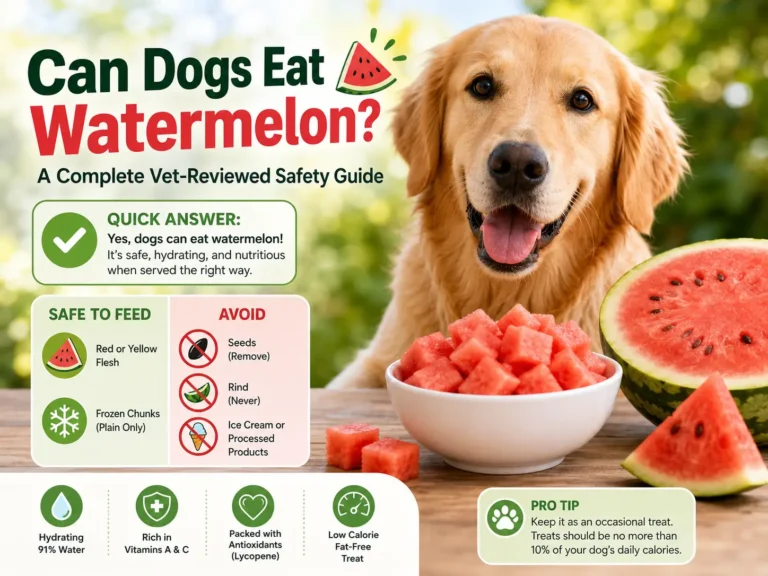
If you want to share a fruity snack with your dog, plenty of options carry no known toxicity risk when given in small amounts. Popular choices include blueberries, seedless watermelon, bananas, apple slices with the seeds and core removed, and strawberries. These are lower in sugar than many other fruits and are commonly recommended by veterinarians as occasional treats. As with any new food, introduce a small amount first and watch for any stomach upset, and check with your vet if your dog has an existing health condition like diabetes or kidney disease before adding new treats to their diet.
How to Prevent Grape Exposure at Home
Read ingredient labels on granola bars, trail mix, and baked goods before leaving them within reach.
Store grapes, raisins, and dried fruit in closed containers on high shelves or inside the refrigerator, not on the counter.
Secure your kitchen trash can with a locking lid, since discarded grape stems and fruit scraps are a common source of exposure.
Check the floor after meals or snacks, especially with kids in the house, since dropped grapes are easy to miss.
Let houseguests know grapes and raisins are off limits for your dog, especially around holidays when baked goods and charcuterie boards are more common.
Frequently Asked Questions
Can dogs have grapes to eat in any amount?
No. There is no confirmed safe amount of grapes for any dog, regardless of size, age, or breed.
Is one grape enough to hurt a dog?
For some dogs, yes. Small dogs are especially at risk, but grape toxicity has been reported in dogs of all sizes. Any amount should be treated as a veterinary emergency, and you should contact your veterinarian or a pet poison hotline immediately.
Can a dog eat grapes if they’re mixed into a dish, like a salad or fruit bowl?
No. Grapes remain toxic whether they are eaten alone or mixed into another food. Remove the food and contact your veterinarian if your dog has eaten any grapes.
Do all dogs react to grapes the same way?
No. Dogs can react very differently to grapes. Some become seriously ill after eating a small amount, while others may show few or no immediate signs. Because there is no way to predict an individual dog’s sensitivity, every exposure should be treated seriously.
Can dogs eat frozen grapes as a summer treat?
No. Freezing grapes does not make them safe. Frozen grapes remain toxic and can also create a choking hazard, especially for small dogs.
Can cats eat grapes too?
No. Grapes and raisins are also considered toxic to cats. If a cat eats grapes or raisins, contact your veterinarian immediately.
Can Dogs Eat Grapes?
No, dogs cannot eat grapes, raisins, sultanas, or Zante currants in any amount or form.
Emergency Reference
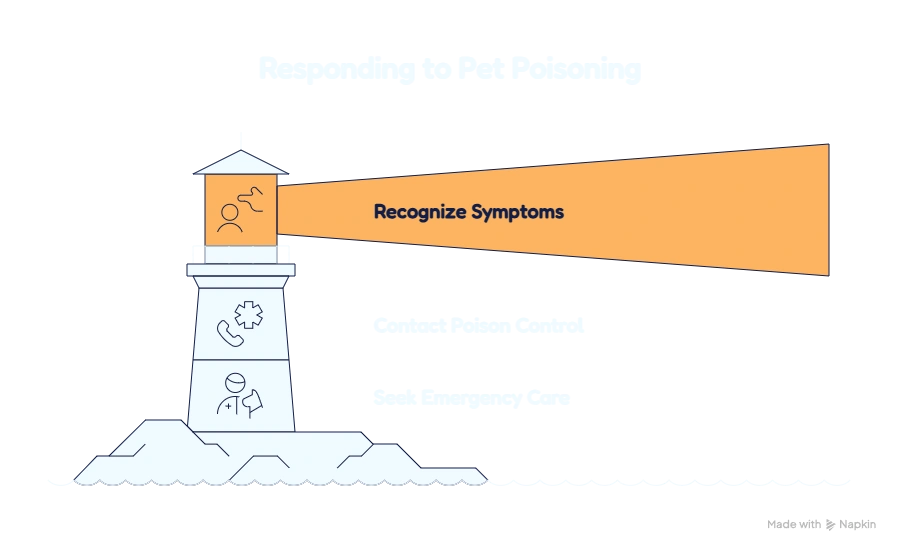
ASPCA Animal Poison Control Center: (888) 426-4435, available 24 hours a day. Pet Poison Helpline: (855) 764-7661, available 24 hours a day.y If your dog is showing severe symptoms such as collapse, seizures, or difficulty breathing, go to the nearest emergency animal hospital immediately.
Medical Review and Sources
This article should be reviewed by a licensed veterinarian before publishing, with the reviewing veterinarian’s name, credentials, and review date displayed here.
Read out our other
Sources
Embrace Pet Insurance. Pet Poison Control Hotline 101.
VCA Animal Hospitals. Grape, Raisin, and Currant Poisoning in Dogs.
ASPCA Animal Poison Control Center (ASPCApro). Toxic Component in Grapes and Raisins Identified.
Written By Dr. Grace Mullen, DVM
Dr. Grace Mullen, DVM, is a veterinarian and Hospital Medical Director with more than 8 years of experience in small animal medicine, with a clinical focus on internal medicine and canine nutrition. A graduate of Michigan State University College of Veterinary Medicine and a member of the American Veterinary Medical Association (AVMA), she writes evidence-based articles that help dog owners make safe, informed feeding decisions. She lives with her two dogs, Milo and Cooper.

Reviewed By By Dr. Bradley Pierson, DVM
Dr. Bradley Pierson, DVM, is a veterinarian with 15+ years of experience in small animal medicine, specializing in internal medicine and preventive care. A graduate of the University of Illinois and Fear Free Certified Professional, she writes to help dog owners navigate food safety at every life stage. She has also volunteered extensively in dog shelter care.